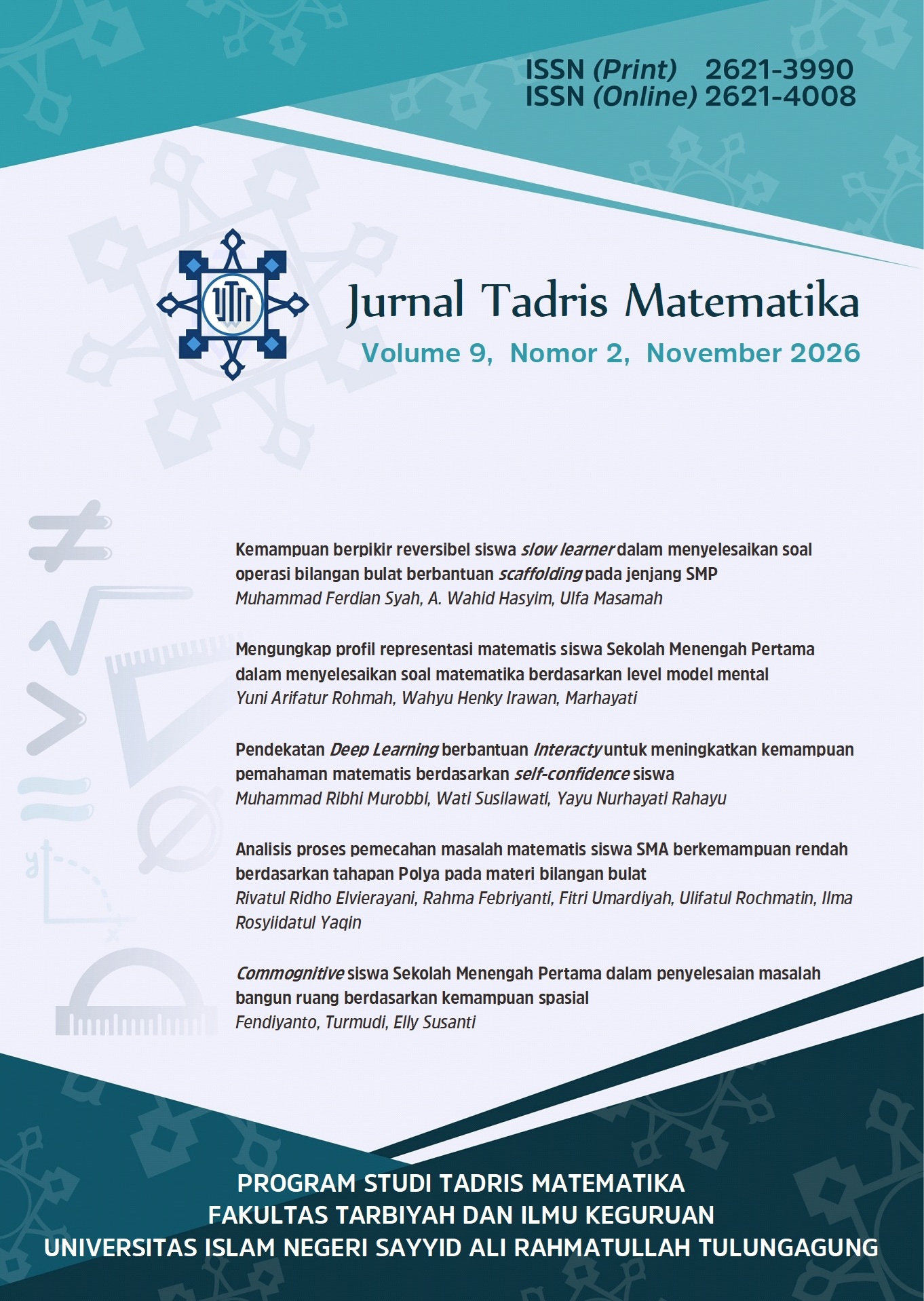
Kemampuan berpikir reversibel siswa slow learner dalam menyelesaikan soal operasi bilangan bulat berbantuan scaffolding pada jenjang SMP
DOI:
https://doi.org/10.21274/jtm.2026.9.2.151-164Keywords:
reversible thinking skills, slow learners, integer operations, scaffoldingAbstract
Research on reversible thinking skills has been mostly conducted on regular students and prospective mathematics teachers, while studies specifically analyzing the reversible thinking skills of slow learner students in solving integer operation problems with the help of scaffolding are still limited. This study aims to analyze the reversible thinking skills of slow learner students in solving integer operation problems at the junior high school level with the help of scaffolding during the data collection process. This study used a descriptive qualitative approach with two slow learner students in class VII selected through purposive sampling as subjects. Data were obtained through tests, semi-structured interviews, and documentation, then analyzed using the Miles and Huberman model and data validity was carried out using technical triangulation. The results showed that the three indicators of reversible thinking skills, namely negation, reciprocity, and return to initial data, could be achieved by both subjects but did not appear independently. Students were only able to demonstrate the process of reversing operations, finding equivalent forms of operations, and returning results to initial values after receiving scaffolding in the form of guiding questions, instructions, and visual representations such as number lines. These findings indicate that slow learners' reversible thinking skills are at a concrete stage and require gradual support to uncover their mathematical thinking processes. This research contributes to enriching the study of the characteristics of slow learners' reversible thinking skills and emphasizes the importance of scaffolding as a form of support that helps students construct and communicate mathematical thinking processes during problem-solving.
Downloads
References
Anggreni, M., Anwar, & Munzir, S. (2025). Pedagogical scaffolding strategies for supporting students with mathematical learning difficulties in special education. Jurnal Elemen, 11(3), 648–668. https://doi.org/10.29408/jel.v11i3.29996
Anisa, S. Y., Sepriyanti, N., & Khaidir, C. (2024). An analysis of students’ reversible thinking mathematical ability on the material of flat sided space geometry. Jurnal Riset Pendidikan Dan Inovasi Pembelajaran Matematika (JRPIPM), 7(2), 85–104. https://doi.org/10.26740/jrpipm.v7n2.p85-104
Badriyah, L., As’ari, A. R., & Susanto, H. (2017). Analisis kesalahan dan scaffolding siswa berkemampuan rendah dalam menyelesaikan operasi tambah dan kurang bilangan bulat. Jurnal Pendidikan: Teori, Penelitian, Dan Pengembangan, 2(1), 50–57. https://doi.org/10.17977/jp.v2i1.8403
Denzin, N. K. (2017). The research act: A theoretical introduction to sociological methods. Routledge. https://doi.org/10.4324/9781315134543
Hanifa, U. N., Prabawanto, S., & Fatimah, S. (2024). Identification of the difficulties of middle school students in understanding the mixed operations of integer. KnE Social Sciences, 9(13), 534–541. https://doi.org/10.18502/kss.v9i13.15956
Kusmaryono, I., Gufron, A. M., & Rusdiantoro, A. (2020). Effectiveness of scaffolding strategies in learning against decrease in mathematics anxiety level. Numerical: Jurnal Matematika Dan Pendidikan Matematika, 4(1), 13–22. https://doi.org/10.25217/numerical.v4i1.770
Maf’ulah, S., Fitriyani, H., Yudianto, E., Fiantika, F. R., & Hariastuti, R. M. (2019). Identifying the reversible thinking skill of students in solving function problems. Journal of Physics: Conference Series, 1188(1), 1–8. https://doi.org/10.1088/1742-6596/1188/1/012033
Maf’ulah, S., & Juniati, D. (2020). The effect of learning with reversible problem-solving approach on prospective-math-teacher students’ reversible thinking. International Journal of Instruction, 13(2), 329–342. https://doi.org/10.29333/iji.2020.13223a
Miles, M. B., & Huberman, A. M. (1994). Qualitative data analysis: An expanded sourcebook. SAGE Publications, Inc.
Miles, M. B., Huberman, A. M., & Saldana, J. (2014). Qualitative data analysis: A methods sourcebook. SAGE Publications, Inc.
Nurlatifah, M., & Hakim, D. L. (2024). Analisis kemampuan berpikir reversible siswa SMP dalam menyelesaikan masalah sistem persamaan linear dua variabel. JP2M (Jurnal Pendidikan Dan Pembelajaran Matematika), 10(1), 130–143. https://doi.org/10.29100/jp2m.v10i1.5396
Paramita, T., Syawaludin, M. F. A., Ningrum, D. A. S., Nisa, Q. A., Ramadan, W. F., Yanti, Y., Tasyah, W. N., & Nirmalasari, D. (2025). Peningkatan hasil belajar siswa pada materi bilangan bulat dengan model scaffolding kelas VII MTs Nurul Islam. Wilangan: Jurnal Inovasi Dan Riset Pendidikan Matematika, 6(1), 10–14. https://doi.org/10.62870/wjirpm.v6i1.31360
Pebrianti, A., & Juandi, D. (2022). Reversible thinking ability in solving mathematics problems. Jurnal Cendekia: Jurnal Pendidikan Matematika, 7(1), 163–173. https://doi.org/10.31004/cendekia.v7i1.1905
Purwaningrum, A., & Sutiarso, S. (2022). Analisis kemampuan reversible thinking peserta didik kelas VIII SMP pada materi sistem persamaan linier dua variabel. Jurnal Cendekia: Jurnal Pendidikan Matematika, 7(1), 39–48. https://doi.org/10.31004/cendekia.v7i1.821
Putra, E. D., Lutfiyah, & Anggraini, S. R. (2021). Analisis kesulitan dan pemberian scaffolding dalam pembelajaran discovery learning. Transformasi: Jurnal Pendidikan Matematika Dan Matematika, 5(2), 589–602. https://doi.org/10.36526/tr.v5i2.1462
Siregar, A. G., & Ananda, R. (2023). Analisis kemampuan reversible mhinking pada materi himpunan di kelas VII SMP Swasta BPI Palu Kurau. Jurnal Cendekia: Jurnal Pendidikan Matematika, 7(2), 1265–1273. https://doi.org/10.31004/cendekia.v7i2.2265
Sugiyono. (2019). Metode penelitian kuantitatif, kualitatif, dan R&D. Alfabeta.
Susilo, C. Y., & Prihatnani, E. (2022). Scaffolding for slow learner children on integer operations. Kreano: Jurnal Matematika Kreatif-Inovatif, 13(1), 113–125. https://doi.org/10.15294/kreano.v13i1.34363
Wafiqoh, R., Maulana, S. A., & Pramuditya, S. A. (2022). Mathematics learning difficulties of slow learner students in terms of reflektif abstraction measurement. AKSIOMA: Jurnal Program Studi Pendidikan Matematika, 11(2), 1052–1062. https://doi.org/10.24127/ajpm.v11i2.4770
Wafiroh, H., & Harun. (2022). The barriers in the implementation of mathematics learning for slow learner during the COVID-19. Jurnal Elemen, 8(1), 144–160. https://doi.org/10.29408/jel.v8i1.4525
Wibowo, T., Darmono, P. B., & Azieta, H. N. (2022). An analysis of the ability to understand mathematical concepts of middle school students in completing integer operations. Mathematics Education Journal, 16(1), 29–44. https://doi.org/10.22342/jpm.16.1.15324.29-44
Downloads
Published
How to Cite
Issue
Section
License
Copyright (c) 2026 Jurnal Tadris Matematika

This work is licensed under a Creative Commons Attribution-ShareAlike 4.0 International License.

Jurnal Tadris Matematika (p-ISSN: 2621-3990, e-ISSN: 2621-4008) by http://ejournal.uinsatu.ac.id/index.php/jtm is licensed under a Creative Commons Attribution-ShareAlike 4.0 International License