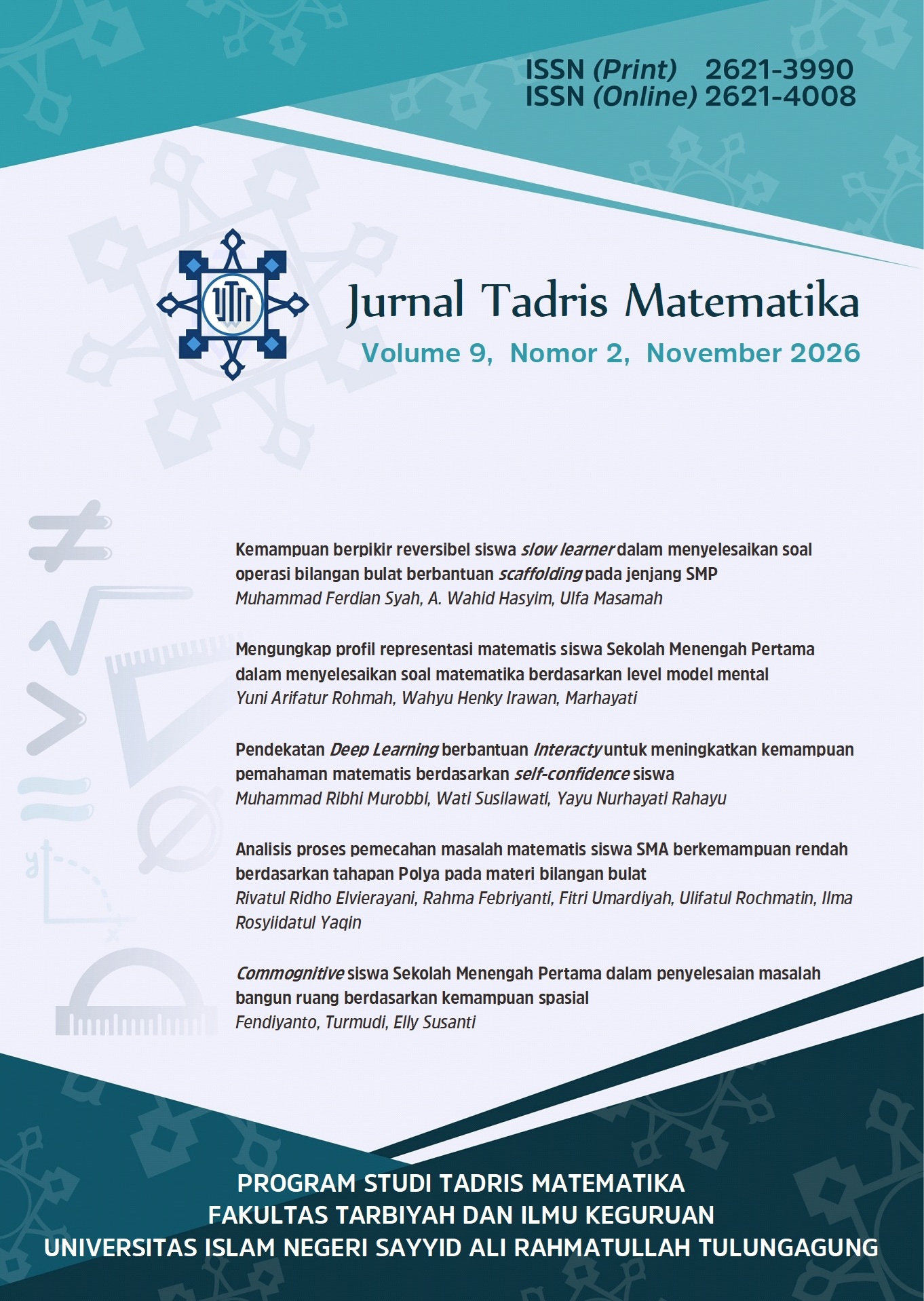
Mengungkap profil representasi matematis siswa Sekolah Menengah Pertama dalam menyelesaikan soal matematika berdasarkan level model mental
DOI:
https://doi.org/10.21274/jtm.2026.9.2.183-198Keywords:
mathematical representation, mental model, visual, symbolic, verbalAbstract
This research aims to describe the mathematical representation profile of junior high school students in solving mathematics problems based on the level of mental models, namely initial, synthetic and formal. The research uses a qualitative approach with an exploratory type. The research subjects consisted of six class IX students at MTsN 2 Malang who were selected based on the results of the initial mental model test. Data was collected through written tests and interviews, then analyzed based on visual, symbolic and verbal representation indicators through the stages of data reduction, categorization and interpretation. The research results show that students with initial mental models tend to use visual and verbal representations, but are not consistent in symbolic representations. Students with synthetic mental models begin to utilize the three representations in a more balanced manner, although the integration is not yet optimal. Meanwhile, students with formal mental models are able to integrate visual, symbolic and verbal representations appropriately and systematically. These findings confirm that the level of mental models influences the quality of students' mathematical representations in problem solving.
Downloads
References
Afriyani, D., Sa’dijah, C., Subanji, S., & Muksar, M. (2018). Characteristics of students’ mathematical understanding in solving multiple representation task based on SOLO taxonomy. International Electronic Journal of Mathematics Education, 13(3), 281–287. https://doi.org/10.12973/iejme/3920
Agustina, Lady. (2022). Model mental matematis siswa dalam memahami konsep segi empat berdasarkan gender. Universitas Negeri Malang.
Craik, K. (1943). The nature of explanation. Cambride University Press.
Duval, R. (2006). A cognitive analysis of problems of comprehension in a learning of mathematics. Educational Studies in Mathematics, 61(1–2), 103–131. https://doi.org/10.1007/s10649-006-0400-z
Eviyanti, R., & Yerizon, Y. (2022). Analisis kemampuan representasi matematis ditinjau dari karakteristik cara berpikir peserta didik. Jurnal Cendekia : Jurnal Pendidikan Matematika, 6(1), 887–897. https://doi.org/10.31004/cendekia.v6i1.1187
Gina, N. M., Jusniani, N., & Budiman, H. (2021). Mathematical representation ability of junior high school students on surface area of cube and cuboid. Prima: Jurnal Pendidikan Matematika, 5(1), 72–82. https://doi.org/10.31000/prima.v5i1.2769
Hajriyanto, M. H., Ratnaningsih, N., & Rahayu, D. V. (2024). Analisis kemampuan representasi matematis Peserta didik pada materi relasi. Primatika : Jurnal Pendidikan Matematika, 13(1), 9–24. https://doi.org/10.30872/primatika.v13i1.2935
Johar, R., & Lubis, K. R. (2018). The analysis of students’ mathematical representation errors in solving word problem related to graph. Jurnal Riset Pendidikan Matematika, 5(1), 96–107. https://doi.org/10.21831/jrpm.v5i1.17277
Johnson-Laird, P. N. (1980). Mental models in cognitive science. Cognitive Science, 4(1), 71–115. https://doi.org/10.1016/S0364-0213(81)80005-5
Lutfi, J. S., & Juandi, D. (2023). Mathematical representation ability: A systematic literature review. Union: Jurnal Ilmiah Pendidikan Matematika, 11(1), 124–135. https://doi.org/10.30738/union.v11i1.14048
Miles, M. B., Huberman, A. M., & Saldaña, J. (2020). Qualitative data analysis: A methods sourcebook (4th ed.). Sage Publications.
Mpuangnan, K. N., Adjei, B. K., & Govender, S. N. (2024). Impact of multiple representations-based instruction on teaching and learning of linear equations. Journal of Pedagogical Sociology and Psychology, 6(1), 58–76. https://doi.org/10.33902/jpsp.202425242
Muniri, M., & Yulistiyah, E. (2022). Representasi matematis siswa dalam menyelesaikan masalah sistem persamaan linear ditinjau dari gaya kognitif reflektif-implusif. Plusminus: Jurnal Pendidikan Matematika, 2(2), 201–210. https://doi.org/10.31980/plusminus.v2i2.1810
NCTM. (2000). Principles and standards for school mathematics. Reston: VA.
Pratiwi, N., Aisyah, N., Susanti, E., & Pratiwi, W. D. (2021). Analysis of junior high school student’s mathematical reasoning ability in solving non-routine problems on material of two-variable linear equation systems. Proceedings of the 1st International Conference on Mathematics and Mathematics Education (ICMMEd 2020). https://doi.org/10.2991/assehr.k.210508.082
Prayekti, N., Nusantara, T., Sudirman, & Susanto, H. (2020). Eighth-grades students’ mental models in solving a number pattern problem. Journal for the Education of Gifted Young Scientists, 8(3), 973–989. https://doi.org/10.17478/JEGYS.708044
Rahmadani, A. (2017). Analisis model mental siswa SMA dengan kemampuan berpikir ilmiah berbeda dalam memahami konsep larutan elektrolit. Seminar Nasional Pendidikan Biologi Dan Saintek II. https://proceedings.ums.ac.id/snpbs/article/view/501
Rosanti, D. (2024). Analisis proses representasi matematis siswa dalam menyelesaikan masalah persamaan garis lurus ditinjau dari gaya belajar honey mumford. Universitas Negeri Malang.
Sabirin, M. (2014). Representasi dalam pembelajaran matematika. Jurnal Pendidikan Matematika, 1(2), 33. https://doi.org/10.18592/jpm.v1i2.49
Sugihartini, R., Amrullah, A., Junaidi, J., & Hayati, L. (2025). Analisis kemampuan representasi matematis siswa ditinjau dari gaya belajar pada materi sistem persamaan linier dua variabel (SPLDV) kelas VIII MTs Mu’allimat NW Anjani tahun pelajaran 2024/2025. Pendas Jurnal Ilmiah Pendidikan Dasar, 10(1). https://doi.org/10.23969/jp.v10i01.23330
Suhandi, A., Samsudin, A., Fratiwi, N. J., Nurdini, N., Feranie, S., Purwanto, M. G., Linuwih, S., & Coştu, B. (2025). Altering misconceptions: How e-rebuttal texts on Newton’s laws reconstructs students’ mental models. Frontiers in Education, 10. https://doi.org/10.3389/feduc.2025.1472385
Suraji, S., Maimunah, M., & Saragih, S. (2018). Analisis kemampuan pemahaman konsep matematis dan kemampuan pemecahan masalah matematis siswa SMP pada materi sistem persamaan linear dua variabel (SPLDV). Suska Journal of Mathematics Education, 4(1), 9–16. https://doi.org/10.24014/sjme.v4i1.5057
Syah, A., Harizahayu, H., Haddar, G. Al, Annisah, A., & Pratiwi, E. Y. R. (2023). Improving students’ mathematical problem-solving ability through the use of external representations. Journal on Education, 5(2), 5313–5323. https://doi.org/10.31004/joe.v5i2.1274
Utami, A. D., Sa’dijah, C., Subanji, & Irawati, S. (2018). Six levels of Indonesian primary school students’ mental model in comprehending the concept of integer. International Journal of Instruction, 11(4), 29–44. https://doi.org/10.12973/iji.2018.1143a
Vosniadou, S., & Brewer, W. F. (1992). Mental models of the earth: A study of conceptual change in childhood. Cognitive Psychology, 24(4), 535–585. https://doi.org/10.1016/0010-0285(92)90018-W
Downloads
Published
How to Cite
Issue
Section
License
Copyright (c) 2026 Jurnal Tadris Matematika

This work is licensed under a Creative Commons Attribution-ShareAlike 4.0 International License.

Jurnal Tadris Matematika (p-ISSN: 2621-3990, e-ISSN: 2621-4008) by http://ejournal.uinsatu.ac.id/index.php/jtm is licensed under a Creative Commons Attribution-ShareAlike 4.0 International License