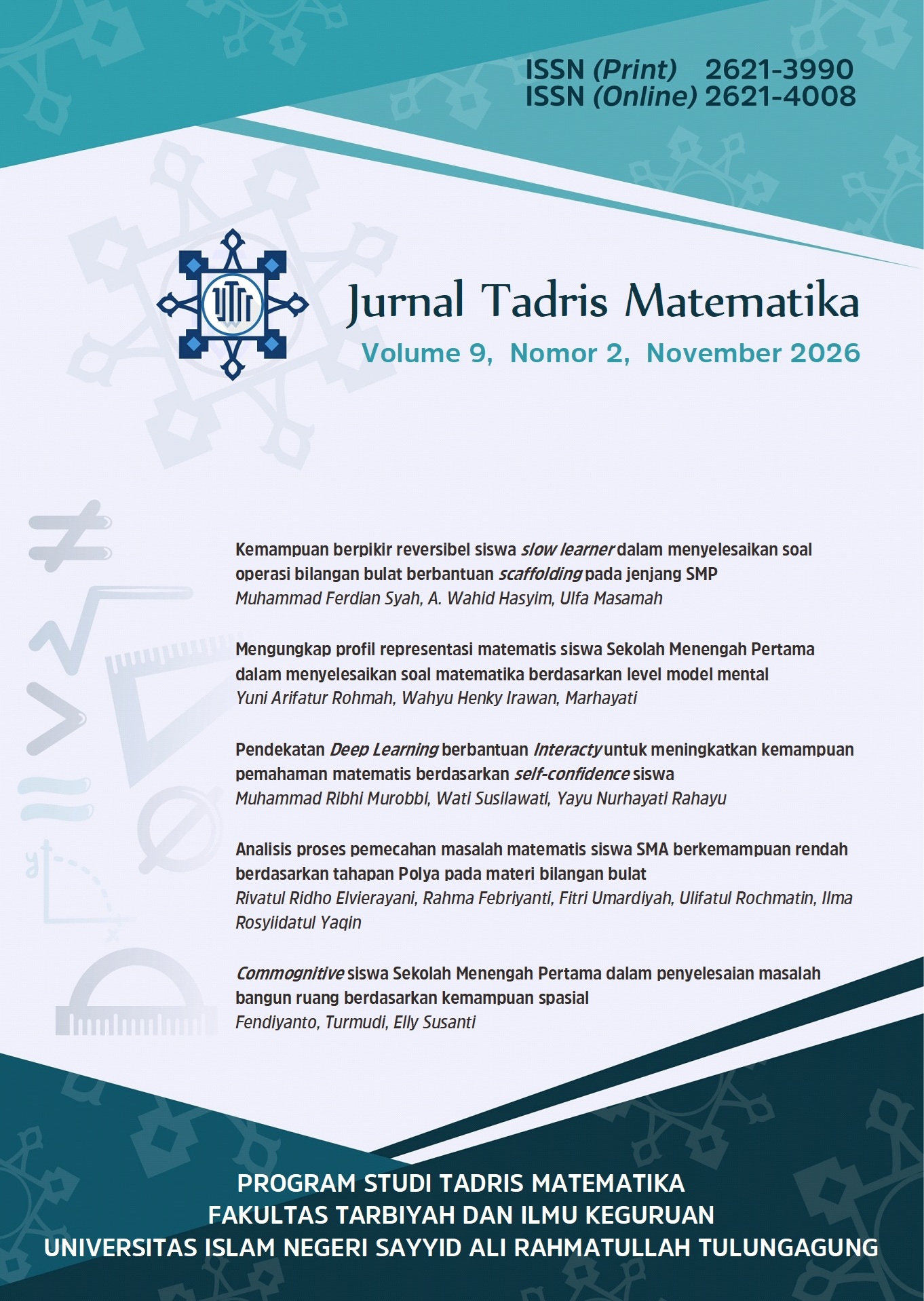
Pendekatan Deep Learning berbantuan Interacty untuk meningkatkan kemampuan pemahaman matematis berdasarkan self-confidence siswa
DOI:
https://doi.org/10.21274/jtm.2026.9.2.199-212Keywords:
Deep Learning, Interacty, mathematical concept understanding, self-confidence, mathematics learningAbstract
Mathematical comprehension ability is essential, must be possessed by students to be able to construct concepts, connect various mathematical representations, and apply knowledge in problem solving. The Deep Learning approach supported by Interacty has the potential to create meaningful, reflective, and student-centered learning experiences that can strengthen conceptual understanding. However, the facts in the field show that students’ mathematical comprehension ability is still relatively low because learning tends to be procedure-oriented and does not utilize interactive technology optimally. The study aims to analyze students’ mathematical comprehension ability through a deep learning approach based on self-confidence. The quasi-experimental design study involved a sample of three grade VIII SMPN in Bandung City in the 2025/2026 academic year consisting of nine parallel classes. By random sampling, three classes were selected, namely VIII-E as experimental class I, VIII-D as experimental class II. And class VIII-F as a conventional class. The instrument used was a description test of students’ mathematical comprehension ability and a non-test self-confidence questionnaire. The results showed that students’ mathematical comprehension ability based on self-confidence, experimental class one ranked first, better than experimental class two and conventional class. The significance of the interaction between learning types and self-confidence on improving mathematical comprehension ability. The Deep Learning approach, supported by Interacty, can increase student engagement in the learning process through interactive, collaborative, and reflective activities, thereby improving students’ mathematical understanding.
Downloads
References
Amri, S. (2018). Pengaruh kepercayaan diri (self confidence) berbasis ekstrakurikuler pramuka terhadap prestasi belajar matematika siswa SMA Negeri 6 Kota Bengkulu. Jurnal Pendidikan Matematika Raflesia, 3(2), 156–170. https://doi.org/10.33369/jpmr.v3i2.7520
Anwar, M. (2024). Penerapan model pembelajaran aktif untuk meningkatkan keterlibatan siswa di kelas VII SMP Negeri 2 Keruak. Jurnal Elhakim Jurnal Ilmu Pendidikan, 1(2), 128–144. https://ejurnal.sayyipelhakim.or.id/index.php/elhakim/article/view/12
Arfia, K., & Handican, R. (2024). Pengaruh self-confidence terhadap prestasi belajar kalkulus di Perguruan Tinggi: Suatu studi korelasional. Teorema: Teori Dan Riset Matematika, 9(2), 305–316. https://doi.org/10.25157/teorema.v9i2.13677
Diana, P., Marethi, I., & Pamungkas, A. S. (2020). Kemampuan pemahaman konsep matematis siswa: Ditinjau dari kategori kecemasan matematik. SJME (Supremum Journal of Mathematics Education), 4(1), 24–32. https://doi.org/10.35706/sjme.v4i1.2033
Fahjri, A. D., Fatimah, S., & Herman, T. (2026). Understanding students’ mathematical communication and self-confidence: Implications for student-centered mathematics classrooms. ALGORITMA Journal of Mathematics Education (AJME), 8(1), 94–108. https://doi.org/10.15408/ajme.v8i1.51187
Febriyani, A., Hakim, A. R., & Nadun. (2022). Peran disposisi matematis terhadap kemampuan pemahaman konsep matematika. PLUSMINUS: Jurnal Pendidikan Matematika, 2(1), 87–100. https://doi.org/10.31980/plusminus.v2i1.1087
Fitdyawati, S. D., In’am, A., & Zukhrufurrohmah. (2025). Mathematical problem-solving ability from the perspective of the computational thinking approach. Kreano, Jurnal Matematika Kreatif-Inovatif, 16(1), 210–227. https://doi.org/10.15294/kreano.v16i1.12197
Fitriani, A., & Santiani. (2025). Analisis literatur: Pendekatan pembelajaran Deep Learning dalam pendidikan. Jurnal Ilmiah Nusantara (JINU), 2(3), 50–57. https://doi.org/10.61722/jinu.v2i3.4357
Gaib, A. F., Ardiyansa, S. A., Wijaya, A. K., Julianto, E., & Gusti, I. (2025). An explainable Deep Learning approach for brain tumor detection using MobileNet and Grad-CAM visualization. CAUCHY – Jurnal Matematika Murni Dan Aplikasi, 10(2), 890–903. https://doi.org/10.18860/cauchy.v10i2.35901
Gea, S., Tilaar, A. L. F., & Sulistyaningsih, M. (2024). Analisis kesulitan siswa dalam belajar matematika pada pembelajaran daring. MARISEKOLA: Jurnal Matematika Riset Edukasi Dan Kolaborasi, 5(2), 77–80. https://doi.org/10.53682/marisekola.v5i2.2561
Gianto, Mariana, N., & Umah, U. (2026). Enhancing learning through Deep Learning: Does it foster elementary students’ conceptual understanding and motivation in mathematics? JMPM: Jurnal Matematika Dan Pendidikan Matematika, 11(1), 23–35. https://doi.org/10.26594/jmpm.v11i1.6373
Gusmiati, Y., & Sulastri. (2023). Analisis kompetensi profesional guru. Jurnal Praktek Pembelajaran Dan Pengembangan Pendidikan, 3(1), 49–55. https://doi.org/10.58737/jpled.v3i1.93
Gusti, V. Y. K., & Amastini, F. (2025). Bridging pedagogy and AI: A systematic review of Deep Learning in mathematics education. Jurnal Pendidikan Matematika (JPM), 11(2), 141–156. https://doi.org/10.33474/jpm.v11i2.24319
Haq, M. D., & Prasetiyo, N. T. (2025). Deep Learning sebagai pendekatan transformasional dalam pendidikan: Sebuah tinjauan literatur. Jurnal Studi Guru Dan Pembelajaran, 8(3), 1826–1842. https://doi.org/10.30605/jsgp.8.3.2025.7021
Haswati, D., Aini, R. N., Selpiyani, & Permadi, U. N. (2019). Pengaruh model pembelajaran PACE terhadap kemampuan pemahaman konsep matematika siswa kelas XI. Jurnal Tadris Matematika, 2(2), 101–110. https://doi.org/10.21274/jtm.2019.2.2.101-110
Juliana, A. Z., Sukmawati, R., & Andriyani, R. (2026). Mathematical literacy as a predictor of learning difficulties in the context of Deep Learning. Desimal: Jurnal Matematika, 09(02), 303–320. https://doi.org/10.24042/djm.v9i2.31737
Kariandinata, R., Hidayat, A., Koswara, U., Hambali, W., & Suganda, A. (2025). Pengaruh antara kinerja dan gaya kepemimpinan kepala sekolah terhadap kompetensi guru di SDN Sukasari Cileunyi Bandung. Jurnal Studi Guru Dan Pembelajaran, 8(2), 1086–1100. https://doi.org/10.30605/jsgp.8.2.2025.6507
Khotimah, N., & Mukmin, M. I. (2024). Pengembangan media pembelajaran matematika integrasi keislaman berbasis digital untuk mendukung implementasi kurikulum merdeka dan profil pelajar pancasila. Jurnal Tadris Matematika, 7(2), 191–206. https://doi.org/10.21274/jtm.2024.7.2.191-206
Komarudin, Yuberti, Pratiwi, D. D., Afandi, M., Wardani, R., & Puspita, L. (2022). Improving students’ mathematic concept understanding viewed from self-efficacy with RME-based Krulik Rudnick heuristic learning model. Indonesian Journal of Science and Mathematics Education, 05(3), 330–340. https://doi.org/10.24042/ijsme.v5i1.13178
Meidianti, A., Kholifah, N., & Sari, N. I. (2022). Kemampuan pemahaman konsep matematis peserta didik dalam pembelajaran matematika. Himpunan: Jurnal Ilmiah Mahasiswa Pendidikan Matematika, 2(2), 134–144. https://jim.unindra.ac.id/index.php/himpunan/article/view/6818
Nazara, R. G. (2026). Teknik penentuan populasi dan sampel dalam penelitian pendidikan. Dinamika Pembelajaran: Jurnal Pendidikan Dan Bahasa, 3(1), 214–225. https://doi.org/10.62383/dilan.v3i1.2932
Nofriyandi, Andrian, D., Effendi, L. A., Firdaus, Ariawan, R., Qudsi, R., Wahyuni, R., Sthepani, A., & Indriani, M. (2021). Peningkatan kemampuan desain media pembelajaran matematika berbasis education for sustainable development guru. Community Education Engagement Journal, 2(2), 21–26. https://doi.org/10.25299/ceej.v2i2.6682
Novitasari, N. T., & Shodikin, A. (2020). Pengaruh penerapan model pembelajaran Logan Avenue Problem Solving (LAPS-heuristik) terhadap kemampuan pemecahan masalah pada soal cerita barisan dan deret aritmetika. Jurnal Tadris Matematika, 3(2), 153–162. https://ejournal.uinsatu.ac.id/index.php/jtm/article/view/3170
Nurandiyani, S. (2025). Aplikasi digital interacty sebagai sarana peningkatan minat baca anak di PAUD al-qur’an Al-Falah Karangkamiri. EXCELLENT (Journal of Islamic Studies), 2(2), 361–371. https://ejournal.alfarabi.ac.id/index.php/excellent/article/view/1113
Nurdiana, A., Zulianti, H., Ciciria, D., Fitria, N., & Kirana, A. R. (2024). Practical applications of Deep Learning in mathematics to enhance student engagement and conceptual mastery. JTAM (Jurnal Teori Dan Aplikasi Matematika), 8(4), 1361–1373. https://doi.org/10.31764/jtam.v8i4.33102
Oktarisa, F., Rahmat, T., & Firmanti, P. (2024). Pengaruh self confidence terhadap hasil belajar matematika. INNOVATIVE: Journal Of Social Science Research, 4(2), 5532–5543. https://j-innovative.org/index.php/Innovative/article/view/10006
Patmaniar, Ilyas, M., Ma’rufi, Alam, S., Taufiq, Nisraeni, & A, F. (2025). Deep Learning dalam Pembelajaran matematika. Abdimas Langkanae, 5(1), 63–71. https://doi.org/10.53769/jpm.v5i1.405
Purnamasari, A., & Afriansyah, E. A. (2021). Kemampuan komunikasi matematis siswa SMP pada topik penyajian data di pondok pesantren. PLUSMINUS: Jurnal Pendidikan Matematika, 1(2), 207–222. https://doi.org/10.31980/plusminus.v1i2.896
Raihan, M. D., Santosa, C. A. H. F., & Yumiati. (2021). Pengaruh model pembelajaran induktif dan self-confidence terhadap kemampuan pemahaman konsep matematik siswa. JPD: Jurnal Pendidikan Dasar, 12(02), 74–92. https://doi.org/10.21009/jpd.v12i02.25806
Salma, E., & Wijayanti, D. (2025). The application of Deep Learning approaches in mathematics learning: A literature review study. Mathematics Education Journals, 9(2), 235–243. https://doi.org/10.22219/mej.v9i2.43853
Salsabila, E., Hajizah, M. N., & Sampoerno, P. D. (2025). Efektivitas desain didaktis materi lingkaran berbasis Realistic Mathematics Education terhadap kemampuan pemahaman konsep matematis. Jurnal Riset Pendidikan Matematika Jakarta, 7(2), 149–158. https://doi.org/10.21009/jrpmj.v7i2.61476
Siregar, T., Fauzan, A., Yerizon, & Syafriandi. (2025). Designing mathematics teaching through Deep Learning pedagogy: Toward meaningful, mindful, and joyful learning. Journal of Deep Learning, 1(2), 188–202. https://doi.org/10.23917/jdl.v1i2.11969
Suri, A., Syofiana, M., & Kashardi. (2026). Development of a digital LKPD on relations and functions to enhance mathematical conceptual understanding. Linear: Journal of Mathematics Education, 7(1), 44–54. https://doi.org/10.32332/linear.v7i1.44-54
Suryanto, M. H., Rohman, F., Mahmuri, A., Nurhanurawati, & Hartono, S. (2025). Pengembangan LKPD berbasis Realistic Mathematics Education untuk meningkatkan pemahaman konsep siswa SD pada pembelajaran matematika. Pendas : Jurnal Ilmiah Pendidikan Dasar, 10(3), 2548–6950. https://doi.org/10.23969/jp.v10i3.29045
Suseno, P. U., Ismail, Y., & Ismail, S. (2020). Pengembangan media pembelajaran matematika video interaktif berbasis multimedia. Jambura Journal of Mathematics Education (JMathEdu), 1(2), 59–74. https://doi.org/10.34312/jmathedu.v1i2.7272
Umam, M. A., & Zulkarnaen, R. (2022). Analisis kemampuan pemahaman konsep matematis siswa dalam materi sistem persamaan linear dua variabel. Jurnal Educatio, 8(1), 303–312. https://doi.org/10.31949/educatio.v8i1.1993
Verina, I., & Darhim, D. (2023). Representasi matematis siswa SMP pada materi bangun ruang. Journal on Mathematics Education Research, 4(2), 125–138. https://doi.org/10.17509/j-mer.v4i2.65077
Wardani, I. U., Mahmudah, R., Yunitasari, D., & Suardipa, I. P. (2025). Penerapan pendekatan Deep Learning untuk mendukung pembelajaran matematika di Sekolah Dasar. Proseding Seminar Nasional Pendidikan Dasar Inovasi Pendidikan Dasar Berbasis Deep Learning, 275–289. https://seminar.ustjogja.ac.id/index.php/semnas_dikdasUST/article/view/3436
Yanuarto, W. N., & Arifudin, I. (2026). Developing augmented reality-based interactive learning media to enhance students’ mathematical communication. Desimal: Jurnal Matematika, 09(02), 1–24. https://doi.org/10.24042/djm.v9i2.31116
Yulaistin, S., & Roesdiana, L. (2022). Analisis kemampuan pemahaman konsep matematis siswa kelas IX SMP pada materi translasi. Jurnal Didactical Mathematics, 4(1), 31–39. https://doi.org/10.31949/dmj.v2i2.2074
Downloads
Published
How to Cite
Issue
Section
License
Copyright (c) 2026 Jurnal Tadris Matematika

This work is licensed under a Creative Commons Attribution-ShareAlike 4.0 International License.

Jurnal Tadris Matematika (p-ISSN: 2621-3990, e-ISSN: 2621-4008) by http://ejournal.uinsatu.ac.id/index.php/jtm is licensed under a Creative Commons Attribution-ShareAlike 4.0 International License