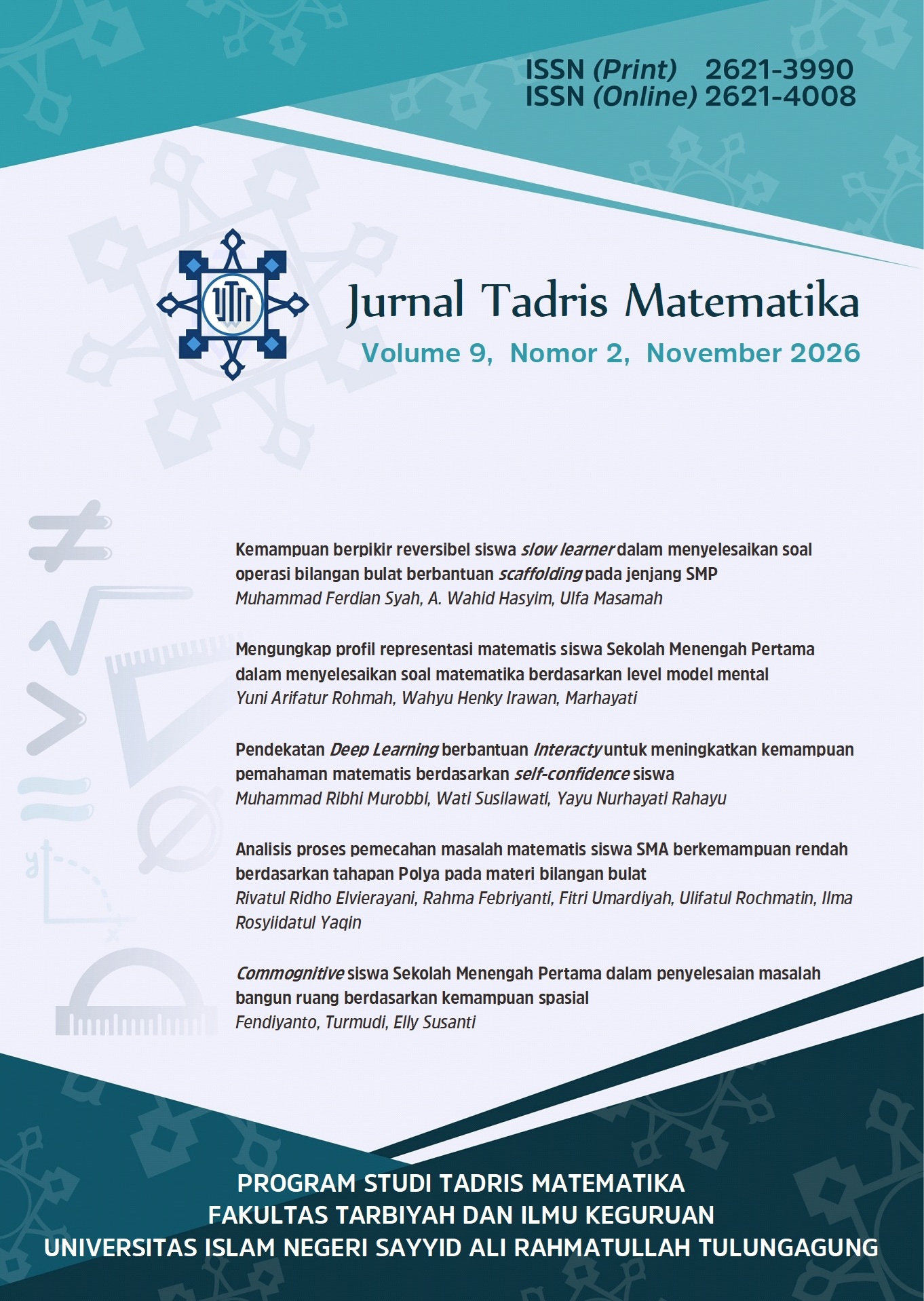
Analisis proses pemecahan masalah matematis siswa SMA berkemampuan rendah berdasarkan tahapan Polya pada materi bilangan bulat
DOI:
https://doi.org/10.21274/jtm.2026.9.2.213-230Keywords:
mathematical problem solving ability, Polya, integers, non-routine problems, high school studentsAbstract
Mathematical problem-solving ability is a crucial competency in mathematics education; however, students continue to struggle with non-routine problems that require reasoning and appropriate strategies. This study aims to analyze the mathematical problem-solving processes of high school students regarding the topic of integers, based on Polya’s stages. A qualitative descriptive approach was employed, involving three students identified by their teacher as having low mathematical ability. Data were collected through written tests and semi-structured interviews, then analyzed according to Polya’s four stages. The results indicate that the three subjects exhibited distinct problem-solving characteristics. Subject S1 carried out the first three stages but failed to perform the "looking back" stage. Subject S2 completed all four stages but was inconsistent in integrating all problem requirements when determining a strategy and verifying the results. Subject S3 also completed all four stages but failed to accurately interpret divisibility relationships, focusing instead on the number 70; while S3 utilized the concept of factors of 70, they did not relate this to all the prMathematical problem-solving ability is a crucial competency in mathematics education; however, students continue to struggle with non-routine problems that require reasoning and appropriate strategies. This study aims to analyze the mathematical problem-solving processes of high school students regarding the topic of integers, based on Polya’s stages. A qualitative descriptive approach was employed, involving three students identified by their teacher as having low mathematical ability. Data were collected through written tests and semi-structured interviews, then analyzed according to Polya’s four stages. The results indicate that the three subjects exhibited distinct problem-solving characteristics. Subject S1 carried out the first three stages but failed to perform the “looking back” stage. Subject S2 completed all four stages but was inconsistent in integrating all problem requirements when determining a strategy and verifying the results. Subject S3 also completed all four stages but failed to accurately interpret divisibility relationships, focusing instead on the number 70; while S3 utilized the concept of factors of 70, they did not relate this to all the problem’s requirements. The findings suggest that the problem-solving process was suboptimal, particularly regarding the interpretation of information, strategy selection, and the execution of a comprehensive review. of information, strategy selection, and the execution of a comprehensive review.
Downloads
References
Andini, F., Yuanita, P., & Suanto, E. (2025). Analisis kemampuan pemecahan masalah matematis siswa SMA pada materi peluang. Juring ((Journal for Research in Mathematics Learning), 6(3), 335–342. https://ejournal.uin-suska.ac.id/index.php/juring/article/view/38070
Arsyabinta, W., Winarni, R., & Surya, A. (2024). Analisis kesulitan pemecahan masalah matematika berdasarkan teori Polya pada peserta didik kelas IV sekolah dasar. Didaktika Dwija Indria, 4(11), 13–18. https://doi.org/10.20961/ddi.v11i4.76962
Chairani, D. F., & Darmawan, P. (2025). Analisis kesalahan siswa dalam menyelesaikan soal cerita materi bilangan bulat berdasarkan teori nolting. SIGMA DIDAKTIKA: Jurnal Pendidikan Matematika, 12(2), 81–96. https://doi.org/10.17509/sigmadidaktika.v12i2.75878
Elvierayani, R. R., Lusiana, R., Suwandayani, B. I., & Silvia, I. A. (2025). Understanding mathematical concepts in students with borderline intellectual functioning: Insights from representational gestures. Jurnal Elemen, 11(4), 930–950. https://doi.org/10.29408/jel.v11i4.31388
Gusmana, I., & Amir, Z. (2024). Pemahaman konsep matematika siswa ditinjau dari motivasi belajar melalui penggunaan media corong berhitung dan kartu pecahan (Studi kajian literatur). Juring (Journal for Research in Mathematics Learning), 7(3), 229–238. https://doi.org/10.24014/juring.v7i3.22992
Hulaima, & Sumantri, C. M. S. (2024). Analisis pengaruh pemahaman konsep terhadap kemampuan pemecahan masalah pada materi teorema Pythagoras. Center of Education Journal, 5(1), 1–9. https://doi.org/10.55757/cejou.v5i1.428
Jäder, J., & Johansson, H. (2025). Exploring students’ conceptual understanding through mathematical problem solving: Students’ use of and shift between different representations of rational numbers between different representations of rational numbers. Research in Mathematics Education, 4802, 1–18. https://doi.org/10.1080/14794802.2025.2456840
Kepa, S. (2024). Analisis kemampuan pemecahan masalah perbandingan trigonometri ditinjau dari gaya belajar siswa SMA Negeri 1 Banda Neira. PARADIGMA: Jurnal Ilmu Pendidikan Dan Humaniora, 10(1), 32–45. https://doi.org/10.62176/paradigma.v10i1.371
Khodijah, S., Mailizar, & Eva, L. M. (2023). Analisis kemampuan pemahaman konsep matematika siswa kelas X SMA Uswatun Hasanah pada materi eksponen dan logaritma. Himpunan: Jurnal Ilmiah Mahasiswa Pendidikan Matematika, 3(2), 283–290. https://jim.unindra.ac.id/index.php/himpunan/article/view/10645
Liljedahl, P., & Santos-trigo, M. (2016). Problem solving in mathematics education. ICME-13 Topical Surveys. https://doi.org/10.1007/978-3-319-40730-2_1
Meidianti, A., Kholifah, N., & Sari, N. I. (2022). Kemampuan pemahaman konsep matematis peserta didik dalam pembelajaran matematika. Himpunan: Jurnal Ilmiah Mahasiswa Pendidikan Matematika, 2(80), 134–144. https://jim.unindra.ac.id/index.php/himpunan/article/view/6818
Miles, M. B., & Huberman, A. M. (1994). Qualitatif data analysis: A sourcebook of new methods. Sage.
Nafisah, K., Turmuzi, M., Triutami, T. W., & Azmi, S. (2022). Analisis kemampuan pemecahan masalah matematis pada materi bangun ruang sisi datar berdasarkan kemampuan awal matematika siswa. Griya Journal of Mathematics Education and Application, 2(3), 719–731. https://doi.org/10.29303/griya.v2i3.213
NCTM. (2000). Principles and standards for school mathematics. Reston: VA.
OECD. (2022). PISA 2022 results the state of learning and equity in education: Vol. I.
Polya, G. (1985). How to solve it: A new aspect of mathematical method. Princeton University Press. https://doi.org/10.1017/cbo9780511616747.007
Rott, B., Specht, B., & Knipping, C. (2021). A descriptive phase model of problem‑solving processes. ZDM – Mathematics Education, 53(4), 737–752. https://doi.org/10.1007/s11858-021-01244-3
Santos-trigo, M. (2024). Problem solving in mathematics education: Tracing its foundations and current research-practice trends. ZDM – Mathematics Education, 56, 211–222. https://doi.org/10.1007/s11858-024-01578-8
Suraji, Maimunah, & Saragih, S. (2018). Analisis kemampuan pemahaman konsep matematis dan kemampuan pemecahan masalah matematis siswa smp pada materi sistem persamaan linear dua variabel (SPLDV). Suska Journal of Mathematics Education, 4(1), 9–16. https://doi.org/10.24014/sjme.v3i2.3897
Wahab A, A., Kusuma, Y. S., Juandi, D., Turmudi, Buhaerah, & Syaiful. (2024). Understanding students’ struggles in solving mathematical problems: A systematic literature review using Polya’s framework. Jurnal Pendidikan Progresif, 14(3), 1728–1753. https://doi.org/10.23960/jpp.v14.i3.202411
Downloads
Published
How to Cite
Issue
Section
License
Copyright (c) 2026 Jurnal Tadris Matematika

This work is licensed under a Creative Commons Attribution-ShareAlike 4.0 International License.

Jurnal Tadris Matematika (p-ISSN: 2621-3990, e-ISSN: 2621-4008) by http://ejournal.uinsatu.ac.id/index.php/jtm is licensed under a Creative Commons Attribution-ShareAlike 4.0 International License