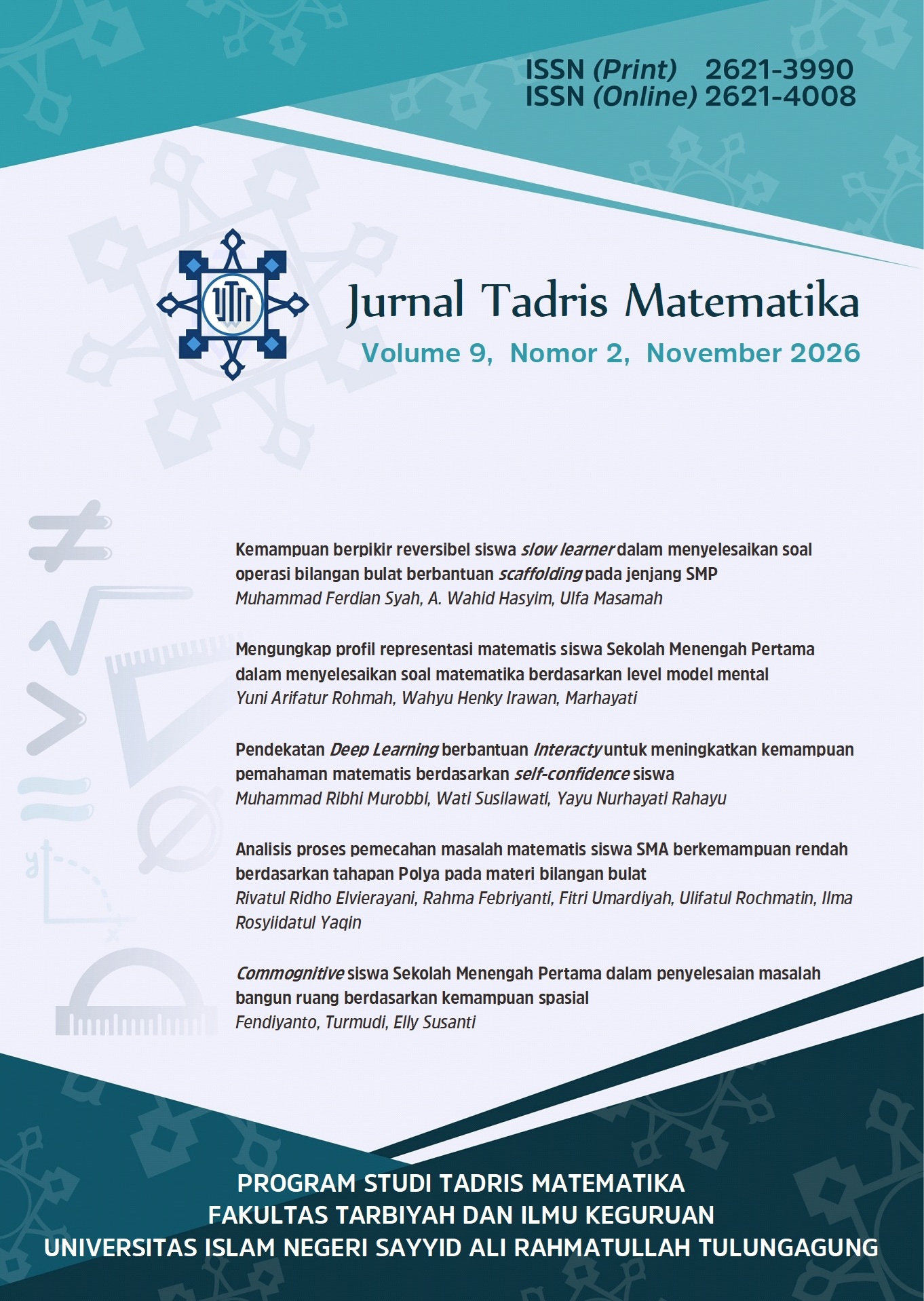
Commognitive siswa Sekolah Menengah Pertama dalam penyelesaian masalah bangun ruang berdasarkan kemampuan spasial
DOI:
https://doi.org/10.21274/jtm.2026.9.2.299-312Keywords:
commognitive, spatial ability, geometryAbstract
This study aims to describe students’ cognitive abilities in spatial problem-solving involving three-dimensional shapes. This study employs a qualitative approach using a descriptive research design involving eighth-grade students at Abdul Malik Fadjar Junior High School in Karangploso Data were collected through tests, think-aloud protocols, and interviews. Data analysis was conducted through the stages of data reduction, data presentation, and drawing conclusions. The results show that: 1) students in the spatial perception category, in the “word use” component, tend to use simple mathematical terms related to three-dimensional shapes. The visual mediator component tends to utilize images as the primary source of information in determining solutions. The narrative component tends to explain solution steps based on visual observations. The routines component tends to use procedures that are ritualistic in nature; 2) students in the mental rotation category, in the word use component, tend to use a more diverse range of mathematical terms. The visual mediator component tends to utilize visual representations. The narrative component tends to explain the relationships between parts of three-dimensional shapes as well as the rationale for using solution strategies. The routines component tends to use procedures that are more exploratory; 3) students in the spatial visualization category, in the word use component, tend to use mathematical terms accurately and meaningfully. In the visual mediator component, they tend to integrate images and symbols during the problem-solving process. In the narrative component, they tend to explain the steps of problem-solving based on conceptual understanding. The routines component indicates a tendency toward an exploratory approach.
Downloads
References
Azustiani, H. (2017). Kemampuan spasial siswa SMP kelas VIII ditinjau dari kemampuan matematika siswa. Prosiding SI MaNIs (Seminar Nasional Integrasi Matematika Dan Nilai-Nilai Islami), 1(1), 293–298. https://conferences.uin-malang.ac.id/index.php/SIMANIS/article/view/92
Christiyanto, D. Y., Sulandra, I. M., & Rahardi, R. (2018). Proses berpikir kritis siswa reflektif dalam menyelesaikan masalah matematika pada materi sistem persamaan linier dua variabel. Jurnal Pendidikan: Teori, Penelitian, Dan Pengembangan, 3(10), 1347–1358. https://doi.org/10.17977/jptpp.v3i10.11679
Hidayat, A., Sa’dijah, C., & Sulandra, I. M. (2019). Proses berpikir siswa field dependent dalam menyelesaikan masalah geometri berdasarkan tahapan Polya. Jurnal Pendidikan: Teori, Penelitian, Dan Pengembangan, 4(7), 923. https://doi.org/10.17977/jptpp.v4i7.12634
Khomeni, A., Junaedi, Y., & Hilmi, Y. (2025). Analisis kemampuan spasial mahasiswa dalam memahami konsep geometri dasar. Wilangan: Jurnal Inovasi Dan Riset Pendidikan Matematika, 6(1), 92. https://doi.org/10.62870/wjirpm.v6i1.32196
Linn, M. C., & Petersen, A. C. (1985). Emergence and characterization of sex differences in spatial ability: A meta-analysis. Child Development, 56(6), 1479–1498. https://doi.org/10.1111/j.1467-8624.1985.tb00213.x
Musayadah, A., Rofikoh, S. R., Syarifah, N. U., & Malik, M. S. (2023). Pengembangan bahan ajar Lembar Kerja Siswa bangun datar dan bangun ruang dengan menggunakan pola barisan. Al-Ihtirafiah: Jurnal Ilmiah Pendidikan Guru Madrasah Ibtidaiyah, 3(2), 96–106. https://doi.org/10.47498/ihtirafiah.v3i02.1711
Nasution, M. A., Rosjanuardi, R., & Kurniawan, S. (2023). Kemampuan pemecahan masalah matematis siswa SMP pada materi bangun ruang sisi datar: Systematic literature review. Jurnal Pembelajaran Matematika Inovatif, 6(4), 1685–1698. https://doi.org/10.22460/jpmi.v6i4.17889
Rahman, M. (2019). 21st century skill “problem solving”: Defining the concept. Asian Journal of Interdisciplinary Research, 2(1), 64–74. https://doi.org/10.34256/ajir1917
Rizqa, A., Syamsuddin, N., & Safrina, K. (2024). Analisis kemampuan spasial matematis ditinjau dari perbedaan gender siswa madrasah aliyah. Numeracy Journal, 11(1), 70–83. https://doi.org/10.46244/numeracy.v11i1.2622
Rossydha, F., Nusantara, T., & Sukoriyanto, S. (2021). Commognitive siswa dalam menyelesaikan masalah persamaan linier satu variabel. Jurnal Pendidikan: Teori, Penelitian, Dan Pengembangan, 6(1), 1. https://doi.org/10.17977/jptpp.v6i1.14367
Sagala, P. R. B., Sitanggang, S., Maharani, S., Saragih, S. R. D., & Manalu, I. R. I. (2024). Analisis kemampuan pemecahan masalah matematika siswa pada materi bangun ruang di kelas VII SMP. Jurnal Basicedu, 8(4), 3075–3084. https://doi.org/10.31004/basicedu.v8i4.8492
Santoso, I. B., Sholihah, U., & Asmarani, D. (2024). Commognitive siswa pada pemecahan masalah materi SPLDV di SMK PGRI Kras Kediri. PERISAI: Jurnal Pendidikan Dan Riset Ilmu Sains, 3(1), 37–48. https://doi.org/10.32672/perisai.v3i1.622
Sari, I. P., Batubara, I. H., Hazidar, A. H., & Basri, M. (2022). Pengenalan bangun ruang menggunakan augmented reality sebagai media pembelajaran. Hello World Jurnal Ilmu Komputer, 1(4), 209–215. https://doi.org/10.56211/helloworld.v1i4.142
Setyowati, S., Purwanto, & Sudirman. (2022). Analisis commognitive siswa dalam menyelesaikan masalah lingkaran ditinjau dari gaya belajar. Jurnal Cendekia: Jurnal Pendidikan Matematika, 6(2), 2336–2351. https://doi.org/10.31004/cendekia.v6i2.1625
Sfard, A. (2018). On the need for theory of mathematics learning and the promise of ‘commognition.’ In P. Ernest (Ed.), The Philosophy of Mathematics Education Today (pp. 219–228). Springer, Cham. https://doi.org/10.1007/978-3-319-77760-3_13
Sopamena, P., Sangkala, N. S., & Rahman, F. J. (2018). Proses berpikir siswa dalam memecahkan masalah matematika berdasarkan teori Piaget pada materi program linear di kelas XI SMA Negeri 11 Ambon. Prosiding SEMNAS Matematika & Pendidikan Matematika IAIN Ambon, 83–92. http://repository.iainambon.ac.id/1504/
Susanti, N. I., & Qohar, A. (2025). Examining the contribution of Baduy ethnomathematics to enhancing non-routine problem-solving skills. SIMFONI: Jurnal Sains Dan Sosial Multidisipliner, 1(1), 42–53. https://jurnal.simfonicindekia.com/index.php/jssm/article/view/37
Usman, R. M., & Kristiawati, A. H. (2025). Systematic literature review: Commognitive dan kemampuan komunikasi matematis. Jurnal MathEdu (Mathematic Education Journal), 8(2), 29–37. https://journal.ipts.ac.id/index.php/MathEdu/article/view/7177
Utami, R. R., Asrin, & Rosyidah, A. N. K. (2022). Analisis kemampuan pemecahan masalah matematika materi bangun ruang siswa kelas V SDN 2 Golong. Jurnal Ilmiah Profesi Pendidikan, 7(3), 1363–1369. https://doi.org/10.29303/jipp.v7i3.766
Wulansari, A., & Adirakasiwi, A. (2024). Analisis kemampuan spasial matematis siswa dalam menyelesaikan masalah matematika. MEGA: Jurnal Pendidikan Matematika, 5(1), 697–705. https://doi.org/10.59098/mega.v5i1.1472
Zayyadi, M., Lutfiyah, & Pratiwi, E. (2023). Analisis commognitive siswa dalam menyelesaikan soal non rutin. Jurnal Axioma: Jurnal Matematika Dan Pembelajaran, 8(1), 22–36. https://doi.org/10.56013/axi.v8i1.1990
Zayyadi, M., Nusantara, T., Subanji, Hidayanto, E., & Sulandra, I. M. (2019). A commognitive framework: The process of solving mathematical problems of middle school students. International Journal of Learning, Teaching and Educational Research, 18(2), 89–102. https://doi.org/10.26803/ijlter.18.2.7
Downloads
Published
How to Cite
Issue
Section
License
Copyright (c) 2026 Jurnal Tadris Matematika

This work is licensed under a Creative Commons Attribution-ShareAlike 4.0 International License.

Jurnal Tadris Matematika (p-ISSN: 2621-3990, e-ISSN: 2621-4008) by http://ejournal.uinsatu.ac.id/index.php/jtm is licensed under a Creative Commons Attribution-ShareAlike 4.0 International License