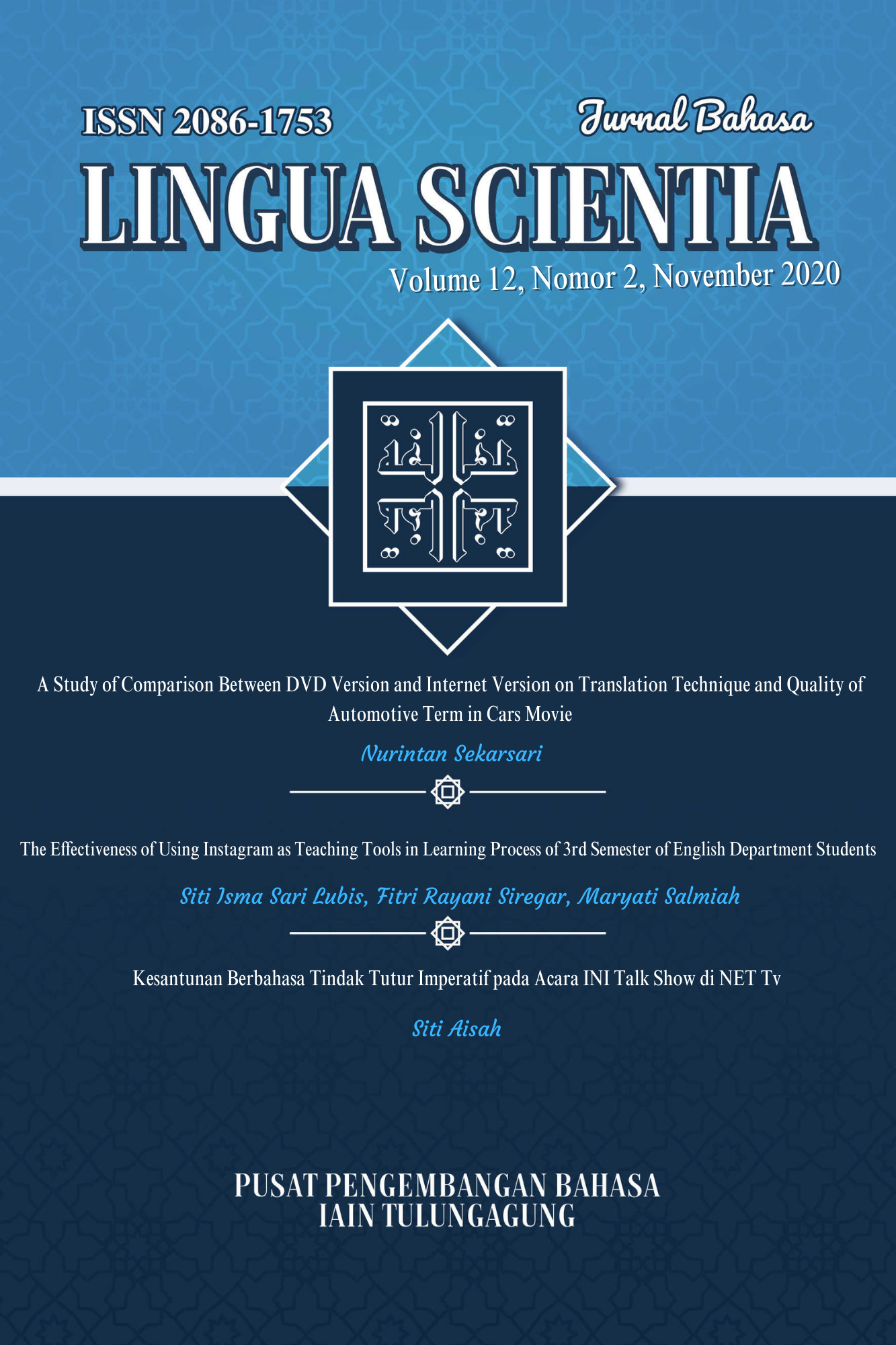
The Effectiveness of Using Instagram as Teaching Tools in Learning Process of 3rd Semester of English Department Students
DOI:
https://doi.org/10.21274/ls.2020.12.2.217-228Keywords:
Effectiveness, Instagram, social media, learning processAbstract
Online learning is one of the big challenges that must be done in this Era. However many people less access and do not use the appropriate media to do it. Besides, they also lack of the application usage. However, Social Media is more popular today. Many people spend their time on social media for communicating, entertaining, selling, and etc. Therefore, using social media as the tool to do the communication in learning is possible to do. One of the popular social media that is used by the students today is Instagram, which has 70 million users in Indonesia. Thus, this research is aimed to find out the effectiveness of using Instagram in online learning. It is specified to the 3rd Semester students of English Department of IAIN Padangsidimpuan. It investigated the participation and feedback of students in learning process while using Instagram as the platform in learning activity. This research used descriptive qualitative research to analyse the students’ perception in implementing Instagram in learning process. The results show that Instagram is effective to be used as the tool for the students’ interaction especially in discussion which is related to the task activity and explanation. Besides, the students felt easier to use this application because it has been used by almost students of the 3rd semester of English Department of IAIN Padangsidimpuan.
Downloads
Downloads
Published
How to Cite
Issue
Section
License
Copyright
Authors who publish with this journal agree to the following terms:
a. Authors retain copyright and grant the journal right of first publication with the work simultaneously licensed under a Creative Commons Attribution-ShareAlike 4.0 International License that allows others to share the work with an acknowledgment of the work's authorship and initial publication in this journal.
b. Authors are able to enter into separate, additional contractual arrangements for the non-exclusive distribution of the journal's published version of the work (e.g., post it to an institutional repository or publish it in a book), with an acknowledgment of its initial publication in this journal.
c. Authors are permitted and encouraged to post their work online (e.g., in institutional repositories or on their website) prior to and during the submission process, as it can lead to productive exchanges, as well as earlier and greater citation of published work (See The Effect of Open Access).