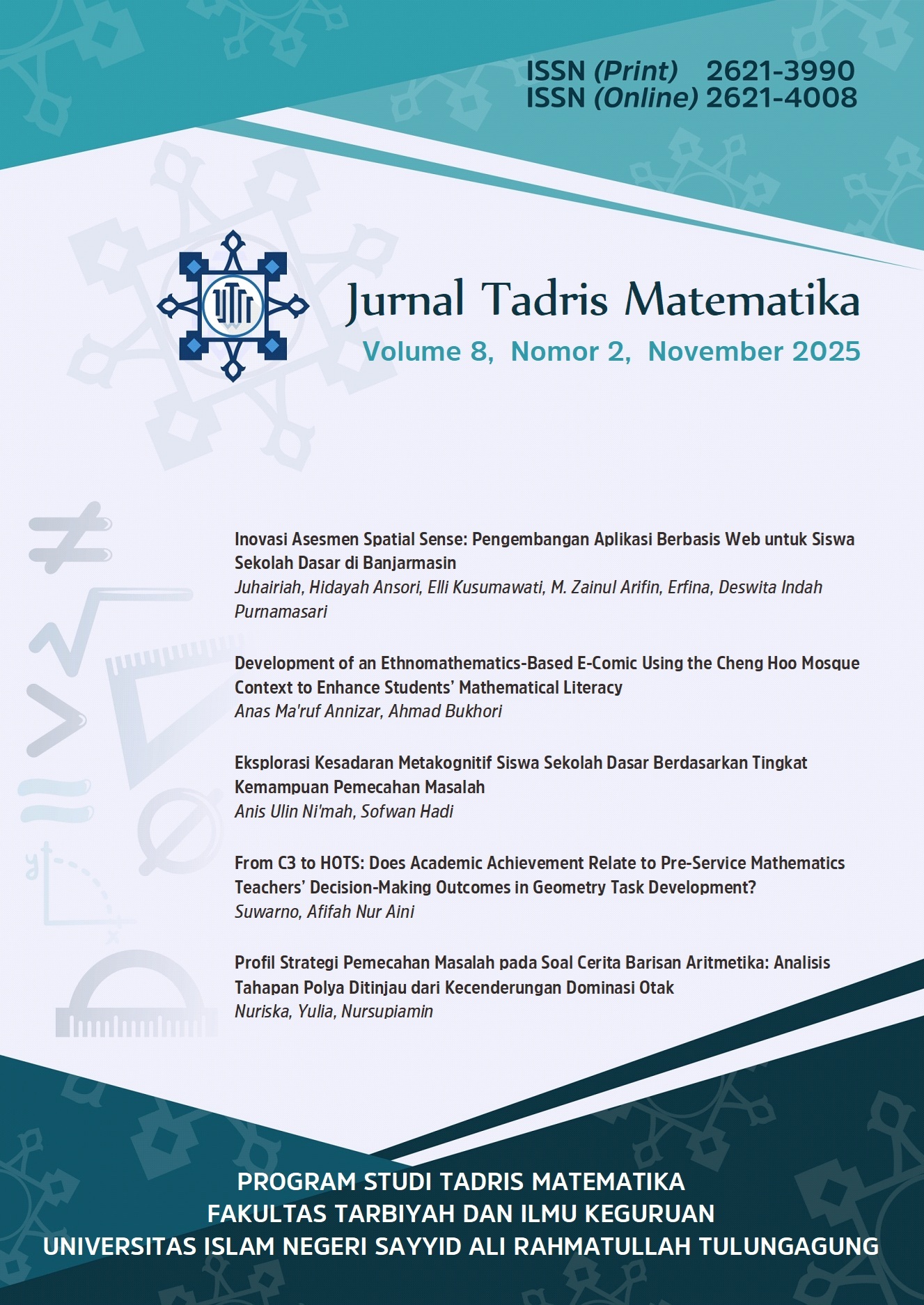
Inovasi Asesmen Spatial Sense: Pengembangan Aplikasi Berbasis Web untuk Siswa Sekolah Dasar di Banjarmasin
DOI:
https://doi.org/10.21274/jtm.2025.8.2.157-168Keywords:
Spatial Sense, Web-Based Assessment, Elementary Mathematics, 4D Development Model, Interactive LearningAbstract
This study aims to develop a web-based spatial sense assessment application for elementary school students in Banjarmasin that is valid and practical for use in mathematics instruction. This is a research and development (R&D) study that employs the 4D model, which includes the define, design, develop, and disseminate stages. The define stage was conducted to analyze teachers’ needs and students’ characteristics; the design stage to design the assessment instrument and application; the develop stage to conduct validation and pilot testing; and the disseminate stage to introduce the application to teachers. The developed instrument consists of 15 items covering three aspects of spatial sense: spatial perception, visualization, and mental rotation. Validation results by experts indicate that the instrument has a very high level of validity, with an average percentage of 93.52%. Results from small- and large-scale pilot tests show that the application is easy to use, engaging, and helps teachers conduct interactive assessments. Thus, the web-based spatial sense assessment application developed is deemed suitable for use as an alternative assessment tool in elementary school mathematics education.
Downloads
References
Arifin, M. Z., Danaryanti, A., & Suryaningsih, Y. (2023). Development of online learning media using GeoGebra and LaTeX on derivative material. Indonesian Journal of Science and Mathematics Education, 6(1), 59–72. https://doi.org/10.24042/IJSME.V6I1.15367
Arifin, M. Z., & Qohar, A. (2024). Development of web-based interactive learning media on quadratic equation materials. EduMa: Mathematics Education Learning and Teaching, 13(1), 10–23. https://doi.org/10.24235/EDUMA.V13I1.14447
Bussi, M. G. B., & Baccaglini-Frank, A. (2015). Geometry in early years: Sowing Seeds for a mathematical definition of squares and rectangles. ZDM Mathematics Education, 47(3), 391–405. https://doi.org/10.1007/S11858-014-0636-5
Damayati, T. Y., Putri, H. E., & Suwangsih, E. (2024). Pengaruh pendekatan concrete pictorial abstract berbantuan Geoboard terhadap kemampuan spatial sense siswa Sekolah Dasar. Pendas : Jurnal Ilmiah Pendidikan Dasar, 9(4), 439–447. https://journal.unpas.ac.id/index.php/pendas/article/view/16795
Fernández, M. I. E., & Uclés, R. R. (2025). Analysis of spatial sense in secondary school students in PISA activities. Avances de Investigación En Educación Matemática, 27(27), 203–221. https://doi.org/10.35763/AIEM27.6538
Hobri. (2010). Metodologi penelitian pengembangan (Aplikasi pada penelitian pendidikan matematika). Pena Salsabila.
Indaryanti, I., Sari, N., Sofia, S., & Lesmana, H. (2025). Asesmen formatif digital: Pendampingan guru MGMP matematika SMP Oku Timur memanfaatkan Artificial Intelligence. Abdi: Jurnal Pengabdian Dan Pemberdayaan Masyarakat, 7(2). https://doi.org/10.24036/abdi.v7i2.1486
Liu, D., Yi, L., & Kang, R. (2025). The impact of a digital game on spatial reasoning for elementary school students. Journal of Computer Assisted Learning, 41(6), e70138. https://doi.org/10.1111/JCAL.70138
Logan, T., & Lowrie, T. (2013). Visual processing on graphics task: The case of a street map. Australian Primary Mathematics Classroom, 18(4), 8–13. https://eric.ed.gov/?id=EJ1093185
Maier, P. H. (1994). Spatial geometry and spatial ability-how to make solid geometry solid? https://webdoc.sub.gwdg.de/ebook/e/gdm/1996/maier.pdf
Martínez-Artero, M. R. N., & Rubio, J. A. R. (2023). An intervention of spatial sense with tinkercad in future teachers. Revista de Educación a Distancia, 23(76). https://doi.org/10.6018/red.562041
Pertiwi, S., Suhendra, S., Nurjanah, N., & Dasari, D. (2023). Solving of polyhedron problems based on spatial sense of Junior High School students. International Journal of Instruction, 16(4). https://doi.org/10.29333/iji.2023.16456a
Riastuti, N., Mardiyana, M., & Pramudya, I. (2017). Students’ errors in geometry viewed from spatial intelligence. Journal of Physics: Conference Series, 895(1). https://doi.org/10.1088/1742-6596/895/1/012029
Riskiani, D., Fauziah, A., & Adha, I. (2025). Systematic literature review: Mengintegrasikan teknologi Artificial Intellegence (AI) dalam pembelajaran matematika. Proceeding of Silampari Conference of Life Science and Technology, 176–185.
Schöner, P., & Benz, C. (2018). Visual structuring processes of children when determining the cardinality of sets: The contribution of eye-tracking. Mathematics Education in the Early Years, 123–143. https://doi.org/10.1007/978-3-319-78220-1_7
Simamora, N. N., Alrefay, K. A., Qasem, A. A., Lorenzo, A., & Kara, M. K. (2024). The influence of teachers’ digital literacy and the use of technology media on students’ ability to identify hoaxes in the digital era. Journal of Educational Technology and Learning Creativity, 2(2), 223–234. https://doi.org/10.37251/JETLC.V2I2.1412
Sudirtha, I. G. (2023). Asesmen pembelajaraan pradigma baru di era merdeka belajar. https://cdn.undiksha.ac.id/wp-content/uploads/2023/01/18062628/12-Orasi-Ilmiah-Prof.-Dr.-I-Gede-Sudirtha-S.Pd_.-M.Pd_.pdf
Sulistyono, B. A., Widodo, S., Katminingsih, Y., Handayani, A. D., Santia, I., & Hima, L. R. (2021). Workshop pengembangan soal dan buku digital berbasis Asesmen Kompetensi Minimum (AKM) bagi guru MGMP matematika SMK Kota Kediri. Jurnal Pengabdian Dan Pemberdayaan Nusantara (JPPNu), 3(2). https://doi.org/10.28926/jppnu.v3i2.63
Thiagarajan, S., Semmel, D. S., & Semmel, M. I. (1974). Instructional development for training teachers of exceptional children. Leadership Training Institute/Special Education. https://eric.ed.gov/?id=ED090725
van Nes, F., & de Lange, J. (2007). Mathematics education and neurosciences: Relating spatial structures to the development of spatial sense and number sense. The Mathematics Enthusiast, 4(2), 210–229. https://doi.org/10.54870/1551-3440.1072
Verdine, B. N., Golinkoff, R. M., Hirsh-Pasek, K., & Newcombe, N. S. (2017). I. spatial skills, their development, and their links to mathematics. Monographs of the Society for Research in Child Development, 82(1), 7–30. https://doi.org/10.1111/MONO.12280
Downloads
Published
How to Cite
Issue
Section
License
Copyright (c) 2025 Jurnal Tadris Matematika

This work is licensed under a Creative Commons Attribution-ShareAlike 4.0 International License.

Jurnal Tadris Matematika (p-ISSN: 2621-3990, e-ISSN: 2621-4008) by http://ejournal.uinsatu.ac.id/index.php/jtm is licensed under a Creative Commons Attribution-ShareAlike 4.0 International License