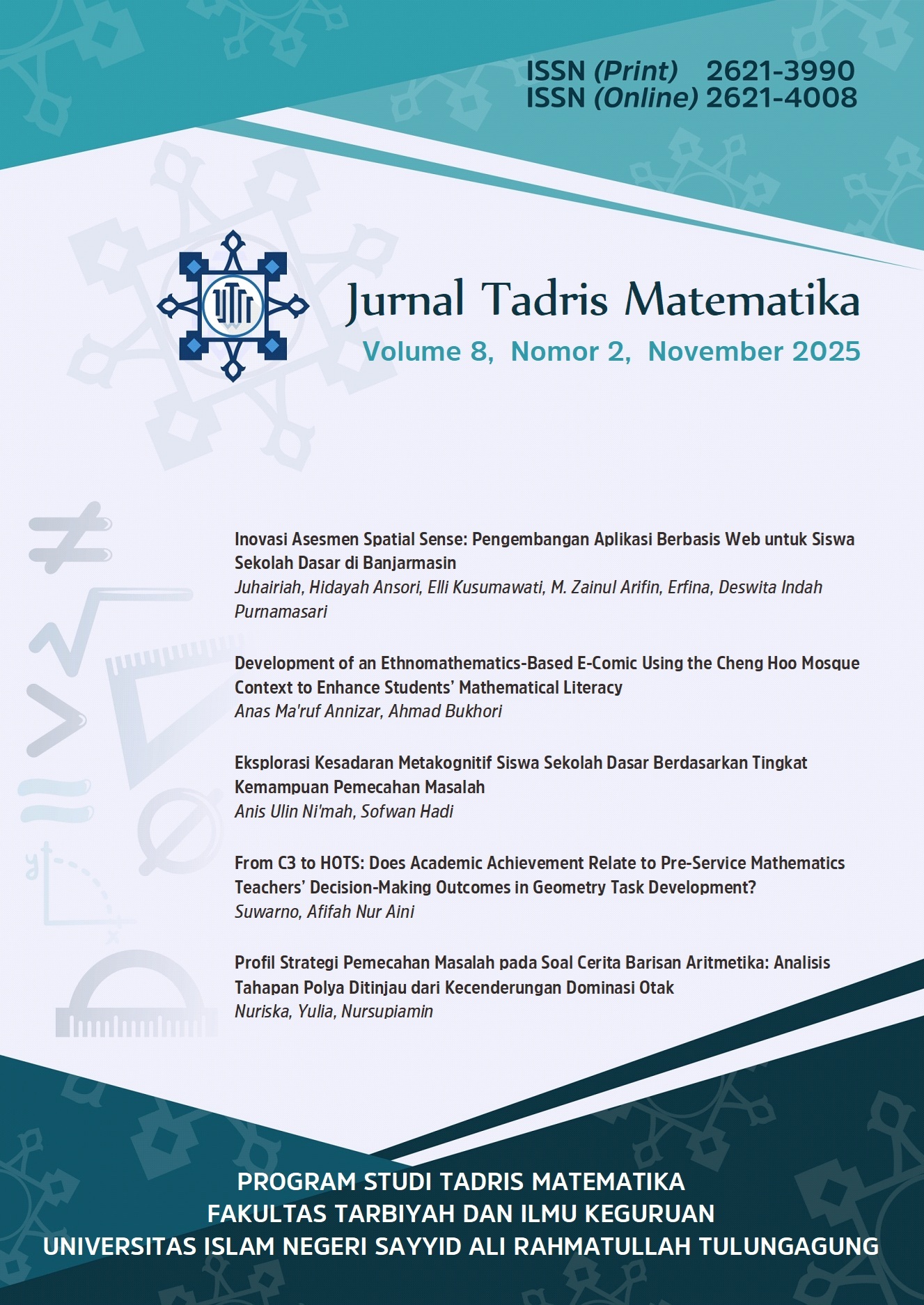
Development of an Ethnomathematics-Based E-Comic Using the Cheng Hoo Mosque Context to Enhance Students’ Mathematical Literacy
DOI:
https://doi.org/10.21274/jtm.2025.8.2.169-188Keywords:
Cheng Hoo Mosque, E-Comic, Ethnomathematics, Mathematical LiteracyAbstract
Mathematical literacy is an essential 21st-century competency that enables students to formulate, use, and interpret mathematical concepts in various real-life contexts. However, Indonesian students’ mathematical literacy remains relatively low, highlighting the need for innovative learning media to support its development effectively. This study aimed to develop and evaluate an ethnomathematics-based e-comic integrating the cultural context of the Cheng Hoo Mosque in Jember to enhance students’ mathematical literacy. This Research and Development (R&D) study employed the ADDIE model, consisting of the Analysis, Design, Development, Implementation, and Evaluation stages. The participants included expert validators, teachers, and eighth-grade students of Al-Falah Silo Junior High School, Jember, Indonesia. Data were collected through expert validation sheets, teacher and student response questionnaires, and mathematical literacy tests. The developed e-comic achieved material and media validation scores of 95.40% and 94.45%, respectively, indicating high validity. Student and teacher responses reached 95.21% and 91.67%, respectively, demonstrating high practicality. Furthermore, students’ mathematical literacy improved significantly, as indicated by the results of an independent-samples t-test (p < 0.001) and a high N-gain score of 0.72. These findings indicate that the ethnomathematics-based e-comic is a valid, practical, and effective learning medium for enhancing students’ mathematical literacy.
Downloads
References
Adeoye, M. A., Adrian, K., Indra, S., Satya, M. S., & Septiarini, N. I. (2024). Revolutionizing education: Unleashing the power of the ADDIE model for effective teaching and learning. Jurnal Pendidikan Indonesia, 13(1), 202–209. https://doi.org/10.23887/jpiundiksha.v13i1.68624
Annizar, A. M., Kholida, A., Alfitriana, A., & Yusuf, A. S. (2021). Pengembangan LKS trigonometri berbasis etnomatematika pada Masjid Cheng-Ho di Kabupaten Jember. Buana Matematika: Jurnal Ilmiah Matematika Dan Pendidikan Matematika, 11(1), 69–88. https://doi.org/10.36456/buanamatematika.v11i1.3564
Annizar, A. M., Maulyda, M. A., Khairunnisa, G. F., & Hijriani, L. (2020). Kemampuan pemecahan masalah matematis siswa dalam menyelesaikan soal PISA pada topik geometri. Jurnal Elemen, 6(1), 39–55. https://doi.org/10.29408/jel.v6i1.1688
Asare, B. (2026). Influence of ethnomathematics-based instruction on students’ attitudes, participation, and cultural connections in mathematics learning in Ghana. Cogent Education, 13(1), 1–13. https://doi.org/10.1080/2331186X.2025.2612395
Azizah, L. N., Tristanti, L. B., & Iffah, J. D. N. (2025). Development of e-comic-based teaching module to enhance students’ mathematical argumentation skills. Jurnal Pendidikan MIPA, 26(4), 2283–2307. https://doi.org/10.23960/jpmipa.v26i4.pp2283-2307
Batiibwe, M. S. K. (2024). The role of ethnomathematics in mathematics education: A literature review. Asian Journal for Mathematics Education, 3(4), 383–405. https://doi.org/10.1177/27527263241300400
Bilad, M. R., Zubaidah, S., & Prayogi, S. (2024). Addressing the PISA 2022 results: A call for reinvigorating Indonesia’s education system. International Journal of Essential Competencies in Education, 3(1), 1–12. https://doi.org/10.36312/ijece.v3i1.1935
Cahyono, B., Setyawati, R. D., & Rohman, M. A. (2025). Development of e-comic mathematics with nuance of religious values and critical thinking of geometry material in Junior High School. International Journal of Social Learning, 5(3), 522–540. https://doi.org/10.47134/ijsl.v5i3.418
Fahreza, V., Sumilat, J. M., Anggraheni, D., Wayansari, C., & Leonard. (2022). The development of e-comic learning media for elementary school mathematics learning. Formatif: Jurnal Ilmiah Pendidikan MIPA, 12(2), 223–236. https://doi.org/10.30998/formatif.v12i2.14238
Faisal, M., Ramdhani, L., & Hardyanti. (2024). Pengaruh penggunaan media animasi terhadap hasil belajar dan motivasi belajar siswa. Jurnal Pendidikan Dan Kebudayaan, 1(4), 18–22. https://doi.org/10.56842/jpk.v1i4.365
Farhan, D., Ikhsan, M., & Elizar, E. (2024). Mathematics e-comic in cultural context to improve student motivation and learning outcomes. Al-Jabar: Jurnal Pendidikan Matematika, 15(2), 445–467. https://doi.org/10.24042/ajpm.v15i2.22327
Fitriyani, Y., Eliyanti, M., & Lestari, M. A. (2021). Penerapan media komik untuk meningkatkan kemampuan literasi dalam memahami soal cerita matematika di Sekolah Dasar. AULADUNA: Jurnal Ilmu Pendidikan Dasar, 8(2), 168–179. https://doi.org/10.24252/auladuna.v8i2a5.2021
Gardose, C. K. C., Castillo, A. A., & Madroñal, M. H. (2025). Comic-Polya method integration in physics: Enhance students’ conceptual understanding and motivation. Indonesia Journal of Education Research, 6(1), 35–44. https://doi.org/10.37251/ijoer.v6i1.1216
Ilhan, A., & Aslaner, R. (2021). Analysis of the correlations between visual mathematics literacy perceptions, reasoning skills on geometric shapes and geometry performances of pre-service mathematics teachers. Participatory Educational Research (PER), 8(1), 90–108. https://doi.org/10.17275/per.21.5.8.1
Kandira, R. V., & Aini, A. N. (2025). Developing math modules to improve students’ mathematical literacy. Educational Insights, 3(1), 54–62. https://eduinsights.id/index.php/eduinsights/article/view/93
Kappassova, S., Abylkassymova, A., Bulut, U., Zhumagulova, Z., Balta, N., & Zykrina, S. (2025). Mathematical literacy and its influencing factors: A decade of research findings (2015-2025). Eurasia Journal of Mathematics, Science and Technology Education, 21(7), 1–19. https://doi.org/10.29333/ejmste/16615
Khasanah, B. A., Charitas, R., Prahmana, I., & Adiputra, S. (2025). The beauty of mathematics in Indonesian culture: An impactful and meaningful context in number patterns learning. Journal of Research and Advances in Mathematics Education, 10(2), 68–80. https://doi.org/10.23917/jramathedu.v10i2.10441
Kolar, V. M., & Hodnik, T. (2021). Mathematical literacy from the perspective of solving contextual problems. European Journal of Educational Research, 10(1), 467–483. https://doi.org/10.12973/EU-JER.10.1.467
Mukhlis, M., & Annizar, A. M. (2025). The development of Islamic mathematics e-comic learning media to improve students’ mathematics communication skills. (JIML) Journal of Innovative Mathematics Learning, 8(3), 628–637. https://doi.org/10.22460/jiml.v8i3.28955
Nadjamuddin, A., Pomalato, S. W., Hulukati, E., & Machmud, T. (2025). The effectiveness of local culture-based mathematics learning in improving the numeracy literacy of students. Journal of Madrasah Ibtidaiyah Education, 9(2), 261–276. https://doi.org/10.32934/jmie.v9i2.850
OECD. (2019). PISA 2018 Assessment and Analytical Framework. OECD Publishing. https://doi.org/10.1787/b25efab8-en
OECD. (2023). PISA 2022 assessment and analytical framework. OECD Publishing.
Panerus, A. C., Irianti, A. H. S., & Prahastuti, E. (2024). Development of iSpring 9-based learning media using android to increase learning independence in basic pattern dimensions. Edunesia: Jurnal Ilmiah Pendidikan, 5(2), 619–639. https://doi.org/10.51276/edu.v5i2.727
Pratama, R. A., & Yelken, T. Y. (2024). Effectiveness of ethnomathematics‑based learning on students’ mathematical literacy: A meta‑analysis study. Discover Education, 3(1), 202. https://doi.org/10.1007/s44217-024-00309-1
Purwoko, R. Y., Purwaningsih, W. I., & Nuryadi. (2024). Development of interactive e-comics based on ethnomathematics oriented towards students’ numeracy skills. AXIOM: Jurnal Pendidikan Dan Matematika, 13(2), 207–218. https://doi.org/10.30821/axiom.v13i2.19807
Rahmata, A., & Ekawati, R. (2021). Pengembangan e-comic matematika berbasis pendidikan matematika realistik (PMR) bermuatan etnomatematika materi aritmetika sosial. MATHEdunesa, 10(1), 32–44. https://doi.org/10.26740/mathedunesa.v10n1.p32-44
Rasmet, R. R., Shaafi, N. F., Sharif, S., Nasir, S., Saleh, M. F. M., & Ellinawati, E. (2025). The impacts of comic-based learning on student engagement in primary education: A systematic literature review. Citra Journal of Innovative Education Practices, 1(1), 26–39. https://doi.org/10.37934/cjiep.1.1.2639
Rosa, M., D’Ambrosio, U., Orey, D. C., Shirley, L., Alangui, W. V., Palhares, P., & Gavarrete, M. E. (2016). Current and future perspectives of ethnomathematics as a program. Springer International Publishing. https://doi.org/10.1007/978-3-319-30120-4
Safitri, W., Yuanita, P., & Suanto, E. (2025). Developing LKPD using the STEAM approach to facilitate the creative mathematical thinking ability of grade X students. Jurnal Gantang, 10(2), 267–277. https://ojs.umrah.ac.id/index.php/gantang/article/view/7375/
Saputra, E. I. S., Sauqi, M. A., Baiti, A. M. N., Widiastuti, B. W., Apprilliyani, L., ’Alimah, C. U., & Arifandi, A. (2024). Akulturasi nilai Islam dengan budaya Tiongkok dalam arsitektur masjid Muhammad Cheng Hoo di Kabupaten Jember. CENDEKIA: Jurnal Penelitian Dan Pengkajian Ilmiah, 1(12), 876–884. https://doi.org/10.62335/s1yygh59
Setyawati, I. A., & Susilo, B. E. (2026). Systematic literature review: Efektivitas peningkatan literasi matematika peserta didik melalui media komik. PAEDAGOGIE, 21(1), 165–178. https://doi.org/10.31603/paedagogie.v21i1.15931
Spaitioti, A. G., Kazanidis, I., & Pange, J. (2022). A comparative study of the ADDIE instructional design model in distance education. Information, 13(402), 1–20. https://doi.org/10.3390/info13090402
Suwarno, Aini, A. N., Ghozali, M. F., Zakariyya, A. M., Ulfa, S. N., & Fitriyanita, N. L. (2025). Pelatihan pembuatan komik digital bertema nilai-nilai moderasi beragama di Taman Bacaan Masyarakat Trinanda Education. JMM (Jurnal Masyarakat Mandiri), 9(1), 823–832. https://journal.ummat.ac.id/index.php/jmm/article/view/28426
Uno, S., Hula, I. R. N., & Tjalau, C. (2024). Development of evaluation and tests using the ProProfs application in arabic language subjects. Maharaat: Jurnal Pendidikan Bahasa Arab, 6(2), 115–139. https://journal.umy.ac.id/index.php/maharat/article/view/25490
Wahab, A., Junaedi, & Azhar, M. (2021). Efektivitas pembelajaran statistika pendidikan menggunakan uji peningkatan N-gain di PGMI. Jurnal Basicedu, 5(2), 1039–1045. https://doi.org/10.31004/basicedu.v5i2.845
Wahidin. (2025). Pengembangan media pembelajaran visual untuk meningkatkan pemahaman konsep siswa. Jurnal Ilmiah Edukatif, 11(1), 285–295. https://journal.iaisambas.ac.id/index.php/edukatif/article/view/3720
Žakelj, A., & Klančar, A. (2022). The role of visual representations in geometry learning. European Journal of Educational Research, 11(3), 1393–1411. https://doi.org/10.12973/eu-jer.11.3.1393
Downloads
Published
How to Cite
Issue
Section
License
Copyright (c) 2025 Jurnal Tadris Matematika

This work is licensed under a Creative Commons Attribution-ShareAlike 4.0 International License.

Jurnal Tadris Matematika (p-ISSN: 2621-3990, e-ISSN: 2621-4008) by http://ejournal.uinsatu.ac.id/index.php/jtm is licensed under a Creative Commons Attribution-ShareAlike 4.0 International License