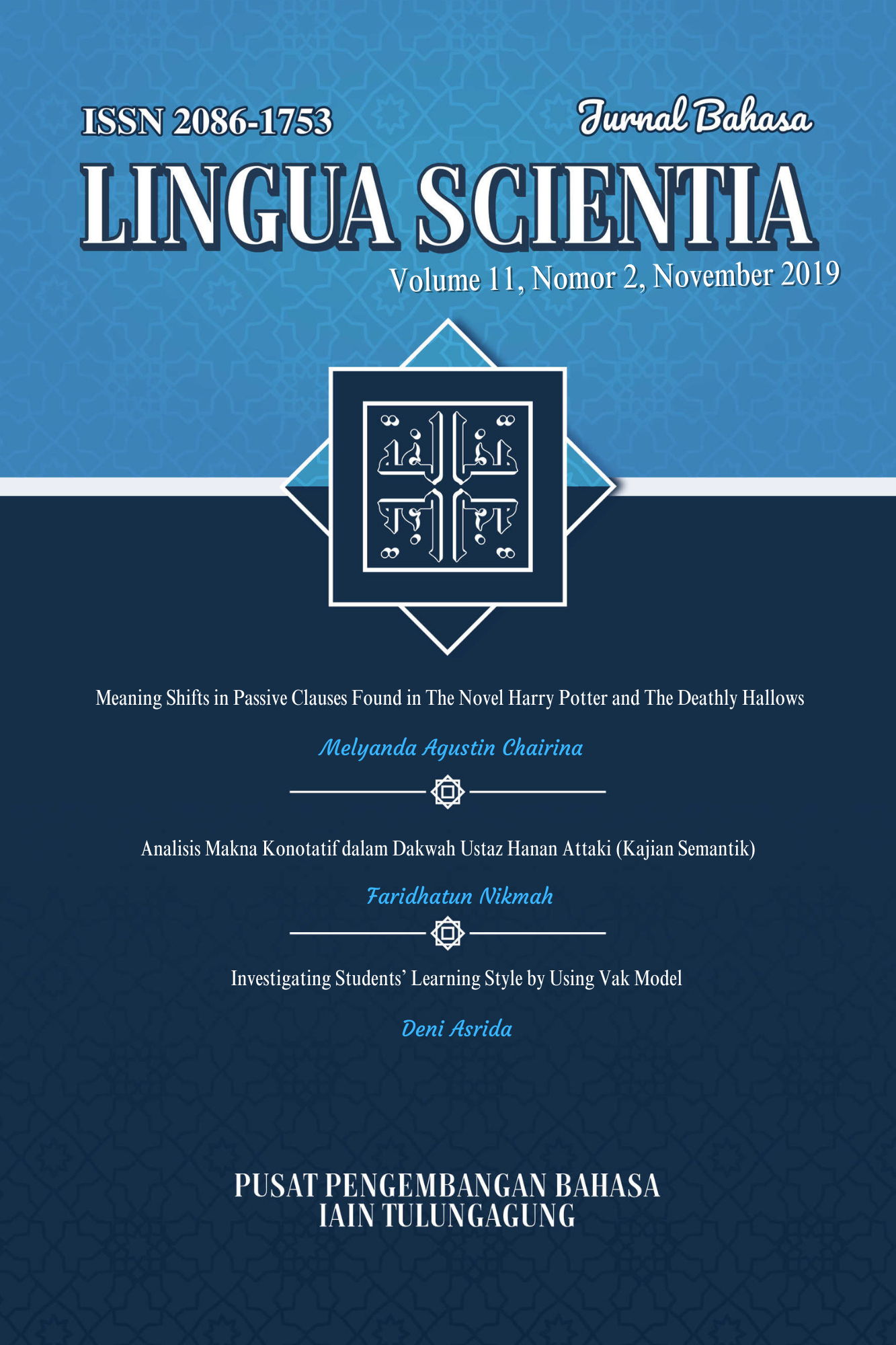
ANALISIS MAKNA KONOTATIF DALAM DAKWAH USTAZ HANAN ATTAKI (KAJIAN SEMANTIK)
DOI:
https://doi.org/10.21274/ls.2019.11.2.219-236Keywords:
Dakwah, Semantic, Connotative Meaning, YoutubeAbstract
This study aims to analyze the meaning of Ustaz Hanan Attaki›s da›wah in semantic studies. This research uses descriptive qualitative method which means the results of the research are not in the form of numbers but rather the results of the description of words. The data source is in the form of Ustaz Hanan Attaki lecture document. In this study the data collected was in the form of a video lecture by Ustaz Hanan Attaki. The technique used in this study was the technique of referring and recording data through transcripts of writing from the results of listening and observing video lecture shows. The results of the study show that there are (a) seven words which include high connotation, such as shade, fragrant, kara, theory, hobbies, perfume; and (b) five words which include the form of friendly connotation meaning, such as the word chasing, understanding, giving, girl, and mature.Downloads
References
Agustina, N. D. (2016). Analisis Penggunaan Makna Denotatif dan Konotatif Pada Penulisan Berita Siswa Kelas VII SMP Negeri 1 Ngrampal Sragen. Universitas Muhammadiyah Surakarta.
Ahmad Zaenudin. (2017). Mengapa Para Dai Bisa Amat Populer di Media Sosial. Tirto.Id.
Alim, S. (2017). Ustaz Seleb dan Proliferasi Media Sosial. Kompasiana.Com.
Artaya, R. A. B. I. P. (2016). Memilih Media Sosial sebagai Bisnis Online Melalui Pendekatan Categorical. Jurnal Manajemen Kinerja, 2(2).
Avrila, T. (2019). Analisis Semiotika Pesan Dakwah dalam Film Keluarga Cemara Tahun 2019. Institut Agama Islam Negeri Tulungagung.
Chaer, A. (2002). Pengantar Semantik Bahasa Indonesia. Jakarta: PT Rineka Cipta.
Deslima, Y. D. (2018). Pemanfaatan Insyagram sebagai Media Dakwah Bagi Mahasiswa Komunikasi dan Penyiaran Islam UIN Raden Intan Lampung. UIN Raden Intan Lampung.
Djajasudarma, F. (2008). Semantik 2 Pemahaman Ilmu Makna (3rd ed.). Bandung: Refika.
Hikmawanti, F. (2017). Metodologi Penelitian. Depok: Rajagrafindo Persad.
Kumparan. (2018). Geliat Dakwah Milenial: Sejuta Pemuda jadi Jemaah. Kumparan.Com.
Kuntoro. (2008). Analisis Wacana Kritis (Teori Van Dijk Dalam Kajian Teks Media Massa. Leksika, 2(2), 45–55.
Latifah, N. (2016). Analisis Semiotik Pesan Dakwah Dalam Film Bulan Terbelah Di Langit Amerika. Universitas Islam Syarif Hidayatullah Jakarta.
Pateda, M. (2001). Semantik Leksikal. (R. Cipta, Ed.). Jakarta.
Rosarita Niken Widiastuti. (2018). PR Dituntut Adaptasi dengan Perkembangan Teknologi Digital. Warta Ekonomi.
Siregar, R. (2018). Ada Apa dengan Usia 40 Tahun? Sindonews.Com.
Suharto. (2017). Media Sosial sebagai Medium Komunikasi Dakwah. Al-Misbah, 13(2).
Suwandi, S. (2011). Semantik Pengantar Kajian Makna (1st ed.). Yogyakarta: Media Perkasa.
Tarigan, H. G. (1985). Pengajaran Semantik. Bandung: Aksara Bandung.
Verhaar. (2001). Asas-asas Linguistik Umum. Yogyakarta: UGM
Downloads
Published
How to Cite
Issue
Section
License
Copyright
Authors who publish with this journal agree to the following terms:
a. Authors retain copyright and grant the journal right of first publication with the work simultaneously licensed under a Creative Commons Attribution-ShareAlike 4.0 International License that allows others to share the work with an acknowledgment of the work's authorship and initial publication in this journal.
b. Authors are able to enter into separate, additional contractual arrangements for the non-exclusive distribution of the journal's published version of the work (e.g., post it to an institutional repository or publish it in a book), with an acknowledgment of its initial publication in this journal.
c. Authors are permitted and encouraged to post their work online (e.g., in institutional repositories or on their website) prior to and during the submission process, as it can lead to productive exchanges, as well as earlier and greater citation of published work (See The Effect of Open Access).