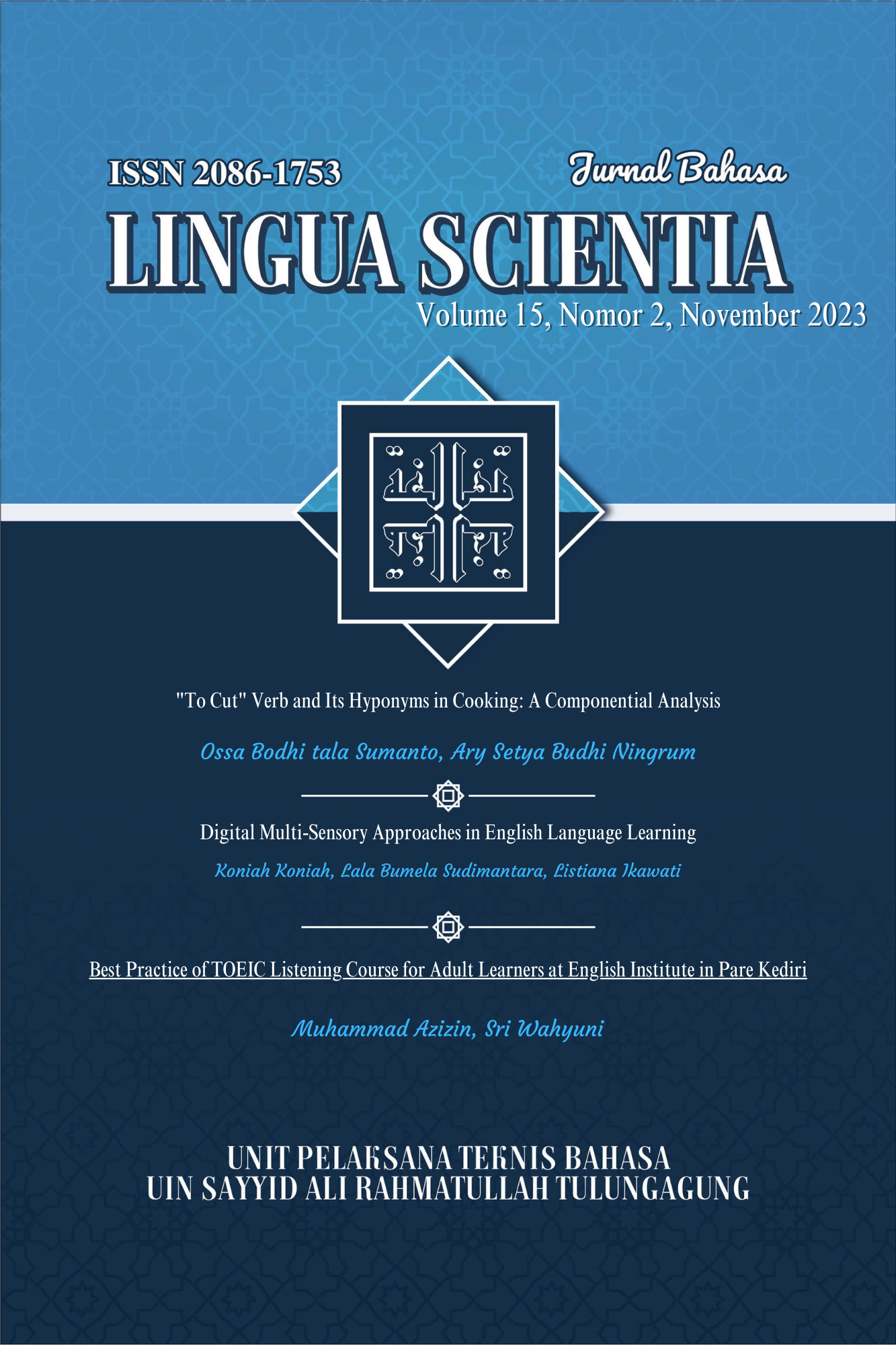
BEST PRACTICE OF TOEIC LISTENING COURSE ADULT LERNERS AT ENGLISH INSTITUTE IN PARE KEDIRI
DOI:
https://doi.org/10.21274/ls.2023.15.2.275-302Keywords:
Adult learner, learning strategies, TOEIC listeningAbstract
Concerns of job applicants have in meeting the requirements for the test of English International Communication (TOEIC). This research aims to analyze the preparation, implementation, evaluation, and obstacle of teaching listening for TOEIC at Merry Institute. The methodology used descriptive qualitative research, meaning the data obtained are described qualitatively. There were 18 students as the subject in this study. The results of observations, interviews, and documentation, as well as interviews with teachers that the teaching and learning process in the classroom has been going well, but some things, such as lesson plans, are not used in the listening for TOEIC program. In the teaching and learning process, the teacher prepares the material well and explains the material using the drilling method to increase the student's grades weekly. Furthermore, the evaluation carried out on listening for TOEIC is to take students' scores on the test simulation every week, and the teacher will evaluate it by discussion after the simulation test if the students do not have an increase in the TOEIC score. The results of this study are a beneficial reference for other institutions in implementing TOEIC listening preparation. Students can use them to improve their scores in understanding the topic of discussion. Further research may be needed to explore Reading comprehension to complement best practices in the test of English international communication.
Downloads
Downloads
Published
How to Cite
Issue
Section
License
Copyright
Authors who publish with this journal agree to the following terms:
a. Authors retain copyright and grant the journal right of first publication with the work simultaneously licensed under a Creative Commons Attribution-ShareAlike 4.0 International License that allows others to share the work with an acknowledgment of the work's authorship and initial publication in this journal.
b. Authors are able to enter into separate, additional contractual arrangements for the non-exclusive distribution of the journal's published version of the work (e.g., post it to an institutional repository or publish it in a book), with an acknowledgment of its initial publication in this journal.
c. Authors are permitted and encouraged to post their work online (e.g., in institutional repositories or on their website) prior to and during the submission process, as it can lead to productive exchanges, as well as earlier and greater citation of published work (See The Effect of Open Access).