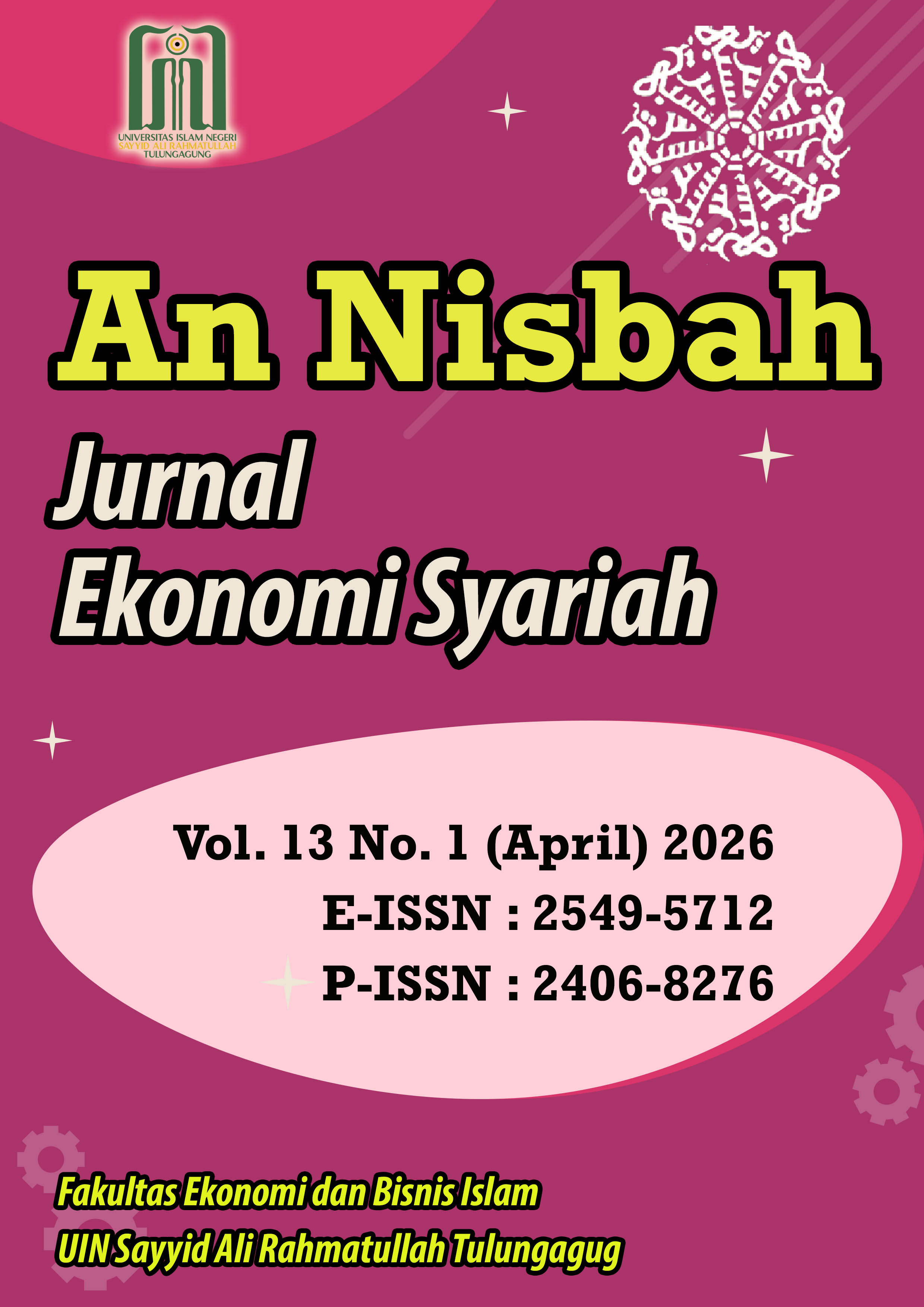
Integrated Halal Infrastructure for Strengthening Indonesia’s Sharia Economic Ecosystem
DOI:
https://doi.org/10.21274/an.v13i1.11504Keywords:
Halal infrastructure, Sharia economy, Institutional integration, Digital traceability, Maqāṣid al-Sharī‘ahAbstract
Indonesia’s growing role in the global halal economy highlights the necessity of a well-developed halal infrastructure that ensures product integrity, strengthens consumer trust, and enhances industry competitiveness. However, existing studies and national practices tend to focus on isolated elements such as certification or logistics, resulting in fragmented implementation and uneven institutional capacity across regions. This study aims to provide an integrated analysis of halal infrastructure covering certification governance, halal laboratory networks, halal logistics, and digital traceability systems and examine how these components collectively reinforce the Sharia economic ecosystem in Indonesia. The analysis also considers how national regulatory frameworks shape institutional coordination, stakeholder roles, and system-wide governance of halal assurance. Using a qualitative Integrative Systematic Literature Review (SLR) supported by policy reports and empirical case documentation, the study synthesizes Institutional Theory, the Resource-Based View, and the maqāṣid al-sharī‘ah framework to analyze structural, operational, and ethical dimensions. This integrative SLR approach is employed to consolidate fragmented interdisciplinary scholarship and construct a unified analytical model of halal infrastructure. The findings show that coordinated institutional arrangements, capacity development of laboratories, and digital integration significantly enhance efficiency and credibility, although disparities remain in regional access and SME readiness. The results also demonstrate that regulatory alignment and multi-stakeholder collaboration are critical determinants of ecosystem performance. The study concludes that holistic infrastructure development is essential for sustainable and inclusive Sharia economic growth, grounded in the normative principles of halal–ṭayyib, maṣlaḥah, and institutional accountability, contributing a conceptual framework to guide future policy and empirical research.
Downloads
References
Bahrudin, M., Iqbal, M. J., Saefurrohman, G. U., & Walsh, J. (2024). Halal Food Industry: Reinforcing the Halal Product Assurance Organizing Body (Bpjph) in the Development of the Among Urban Muslim Community in Indonesia. Akademika Jurnal Pemikiran Islam. https://doi.org/10.32332/akademika.v29i1.9039
Barney, J. (1991). Firm Resources and Sustained Competitive Advantage. Journal of Management, 17(1), 99–120. https://doi.org/10.1177/014920639101700108
Bux, C., Varese, E., Amicarelli, V., & Lombardi, M. (2022). Halal Food Sustainability Between Certification and Blockchain: A Review. Sustainability. https://doi.org/10.3390/su14042152
Destriyansah, W., Imsar, I., & Harahap, M. I. (2023). Analysis of the Influence of the Halal Industry on Indonesia’s Economic Growth. Wiga Jurnal Penelitian Ilmu Ekonomi. https://doi.org/10.30741/wiga.v13i2.1117
DiMaggio, P. J., & Powell, W. W. (1983). The Iron Cage Revisited: Institutional Isomorphism and Collective Rationality in Organizational Fields. American Sociological Review, 48(2), 147–160. https://doi.org/10.2307/2095101
Dusuki, A. W., & Abdullah, N. I. (2007). Maqasid al-Shari`ah, Maslahah, and Corporate Social Responsibility. American Journal of Islamic Social Sciences, 24(1), 25–45.
Fernando, Y., Wahyuni-TD, I. S., Abideen, A. Z., & Mergeresa, F. (2022). Traceability Technology, Halal Logistics Brand and Logistics Performance: Religious Beliefs and Beyond. Journal of Islamic Marketing. https://doi.org/10.1108/jima-06-2020-0183
Haleem, A., Khan, M. I., & Khan, S. (2020). Conceptualising a Framework Linking Halal Supply Chain Management With Sustainability: An India Centric Study. Journal of Islamic Marketing. https://doi.org/10.1108/jima-07-2019-0149
Hidayat, Y., & Machmud, A. (2024). The Existence and Consistency of Halal Certificates in the Global Ecosystem of Halal Products and Services. Amwaluna Jurnal Ekonomi Dan Keuangan Syariah. https://doi.org/10.29313/amwaluna.v8i1.2975
Indonesia, B. K. A. R. (2024). Laporan Penyelenggaraan Jaminan Produk Halal Tahun 2024. In Badan Penyelenggara Jaminan Produk Halal (BPJPH). BPJPH. https://bpjph.kemenag.go.id
Judijanto, L., Mokodenseho, S., Birah, I. F., Mamonto, A., & Mokodongan, G. L. (2024). The Role of Sharia Risk Management, Islamic Investment Ethics, and Riba-Free Financing in the Development of the Halal Industry in Indonesia. Jurnal Multidisiplin West Science. https://doi.org/10.58812/jmws.v3i03.1061
Kamali, M. H. (2008). Maqasid al-Shari’ah Made Simple. International Institute of Islamic Thought (IIIT).
Kodirov, F. A. (2022). Infrastructural Aspects of Increasing the Competitiveness of Industrial Enterprises of the Republic of Tajikistan in Modern Conditions. Vestnik Bist (Bashkir Institute of Social Technologies). https://doi.org/10.47598/2078-9025-2022-1-54-22-28
Nasional, K. A. (2024). Direktori Laboratorium Terakreditasi Halal Tahun 2024. In Komite Akreditasi Nasional (KAN). KAN. https://kan.or.id
North, D. C. (1990). Institutions, Institutional Change and Economic Performance. Cambridge University Press.
Pratama, N. B., & Deniesa, S. (2023). Legal Protection for Tik Tok Shop Buyers: Comparison Between China and Indonesia. Indonesian Comparative Law Review. https://doi.org/10.18196/iclr.v5i2.17298
Scott, W. R. (2001). Institutions and Organizations. In Foundations for Organizational Science. Sage Publications.
Tieman, M., der Vorst, J. G. A. J. van, & Ghazali, M. C. (2012). Principles in Halal Supply Chain Management. Journal of Islamic Marketing. https://doi.org/10.1108/17590831211259727
Titisari, R. (2024). Motivation for Implementing Halal Standards in Umkm Food and Beverage DKI Jakarta. Ekombis Review Jurnal Ilmiah Ekonomi Dan Bisnis. https://doi.org/10.37676/ekombis.v12i4.6406
Trimulato, T., Syarifuddin, S., Umar, S. H., & Lorenza, P. (2022). The Role Halal Industry to Support Sustainable Development Goals (SDGs). Aciel. https://doi.org/10.21107/aciel.v1i2.90
Wernerfelt, B. (1984). A Resource-Based View of the Firm. Strategic Management Journal, 5(2), 171–180. https://doi.org/10.1002/smj.4250050207
Yap, C. K., & Al-Mutairi, K. A. (2023). Effective Microorganisms as Halal-Based Sources for Biofertilizer Production and Some Socio-Economic Insights: A Review. Foods. https://doi.org/10.3390/foods12081702
Downloads
Published
How to Cite
Issue
Section
License
Copyright (c) 2026 Achmad Riady, Arif Mashuri, Siradjuddin .

This work is licensed under a Creative Commons Attribution-ShareAlike 4.0 International License.
The author has full rights to the articles that has been sent to An-Nisbah: Jurnal Ekonomi Syariah. The author is responsible for the originality of the articles and all the references used in the journal script.





 FACULTY OF ISLAMIC ECONOMICS AND BUSSINES