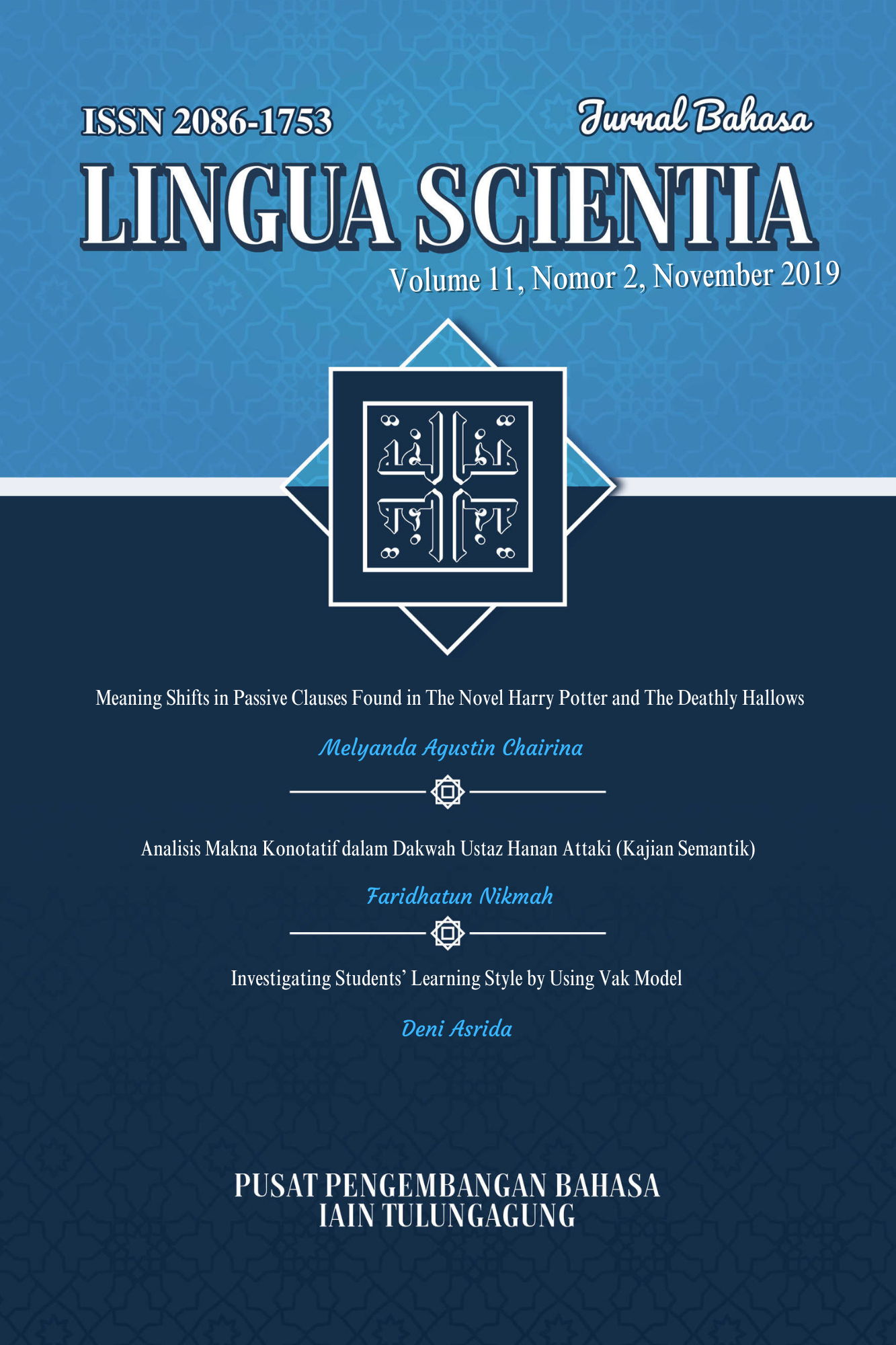
INVESTIGATING STUDENTS’ LEARNING STYLE BY USING VAK MODEL
DOI:
https://doi.org/10.21274/ls.2019.11.2.237-248Keywords:
Learning style, Visual, Kinesthetic, AuditoryAbstract
This study was aimed to investigate students learning style of the second semester students of English Department of IAIN Batusangkar in 2017/2018 academic year. The design of this research was descriptive quantitative. In collecting the data, the researcher used questionnaires which was constructed according to the indicators gotten from the theories. Meanwhile, to see the validity and reliability of the questionnaire, it was tried out to some selected respondents. In analysing the data, the researcher used SPSS 21 for descriptive analysis. Based on the data analysis, it was found two students tend to have visual learning style or 3,5%. Meanwhile, 39 students have auditory learning style 68,42% and 16 students have a tendency kinesthetic learning style 28,7%. It is also can be seen that most of students, 68,42%, have auditory learning style as the dominant learning style.Downloads
References
Biggs, J. (2001). Enhancing learning: A matter of style or approach? In R. J. Sternberg & L.-f. Zhang (Eds.), The educational psychology series. Perspectives on thinking, learning, and cognitive styles (pp. 73-102). Mahwah, NJ, US: Lawrence Erlbaum Associates Publishers.
Brown, H. D. (2000). Principles of language teaching and learning, (4th ed.). White Plains, NY: Longman.
Celce-Murcia, M. (2001). Teaching English as a second or foreign language, (3rd ed.)
DePorter, B., & Hernacki M. (1992). Quantum Learning: Unleashing the Genius in You.Dell Publishing Group.
DePorter, Bobbi. 1999. Quantum Teaching: Dewey Publishing Services: NY.
Drago, W. A., & Wagner, R. J. (2004). Vark Preferred Learning Styles and Online Education. Management Research News, 27, 1-13. http://dx.doi.org/10.1108/01409170410784211
Gay, L. R 2000. Educational Reearch: Competences for Analysis and Application (Six Edition). New Jersey:Merril Publishing Company.
Jensen, Eric & LeAnn Nickelsen. (2011). Deeper Learning: 7 Strategi Luar Biasa untuk Pembelajaran yang Mendalam dan Tak Terlupakan. Jakarta: PT indeks.
Sudijono, Anas. 2000. Pengantar Statistik Pendidikan. Jakarta: PT. Raja Grafindo Persada
Rassol, G.H., & Rawaf S. (2008). The Influence of Learning Styles Preference of Undergraduate Nursing Students on Educational Outcomes in Subtance Use Education. Nurse education in practice, Vol 8 September 2018.
Vermunt, J.D.H.M., (1992). Learning styles and regulation of learning in higher education – toward process-oriented instruction in autonomous thinking, Amsterdam/Lisse, Swets & Zeitlinger.
Downloads
Published
How to Cite
Issue
Section
License
Copyright
Authors who publish with this journal agree to the following terms:
a. Authors retain copyright and grant the journal right of first publication with the work simultaneously licensed under a Creative Commons Attribution-ShareAlike 4.0 International License that allows others to share the work with an acknowledgment of the work's authorship and initial publication in this journal.
b. Authors are able to enter into separate, additional contractual arrangements for the non-exclusive distribution of the journal's published version of the work (e.g., post it to an institutional repository or publish it in a book), with an acknowledgment of its initial publication in this journal.
c. Authors are permitted and encouraged to post their work online (e.g., in institutional repositories or on their website) prior to and during the submission process, as it can lead to productive exchanges, as well as earlier and greater citation of published work (See The Effect of Open Access).