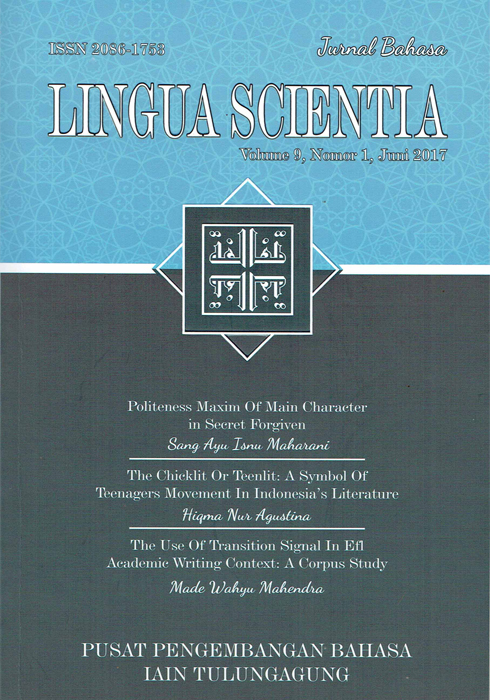
STRATEGI MAHASISWA UNTUK MENGHILANGKAN RASA CEMAS KETIKA BERBICARA BAHASA INGGRIS DI KELAS
DOI:
https://doi.org/10.21274/ls.2017.9.1.27-40Keywords:
strategi, kecemasan berbicaraAbstract
Speaking anxieties become a big problem for the students in learning english nowadays. This paper discusses about students strategies in overcoming speaking anxieties in front of the class and its causing factors. Based on the finding, it is found that there are some factors caused students speaking anxietiesin the class namely students were afraid in making mistakes, they have little confidence in speaking english, they often lose their ideas when speaking in front of the class, they also afraid speaking spontaneously in the class. Meanwhile, it is also found that the students applied some strategies in overcoming speaking anxieties in the class namely the students try to be rilexs during speaking class, make a notes, consider there is no audience seeing his/her performance, practice in front of the mirrorr, practice with their classmate.Downloads
References
Atkinson. 1996. Penghantar Psikologi, Terjemahan Kusuma W, Jakarta: Erlangga
Gay.L.R and Peter Airasian. 2000. Educational research: competencies for analysis and application. Unites states of America: Merril Publishing Company
Helena, Olii. 2010. Public Speaking, Jakarta: Indeks
Hurlock. 1997. Psikologi Perkembangan Suatu Pendekatan Sepanjang Rentang Kehidupan, Jakarta: Erlangga
Lexy J. Molleong. 2006. Metodologi Penelitian Kualitatif. Bandung: PT. Remaja Rosda Karya
Miles, Matthew B. and A. Michael Huberman. 1994. Qualitative Data Analysis (Second Edition). California: Sage Publication
Syaiful Bahri Jamarah dan Aswan Zein, 1997. Strategi Belajar Mengajar, Jakarta : Rineka Cipta
Sugiyono. 2007. Metode Penelitian Pendidikan, Pendekatan Kuantitaitif, Kualitatif, dan R&D. Bandung: Alfabeta
Wassid, Iskandar.2011. Strategi pembelajaran bahasa.Bandung:PT Remaja Rosdakarya
Downloads
Published
How to Cite
Issue
Section
License
Copyright
Authors who publish with this journal agree to the following terms:
a. Authors retain copyright and grant the journal right of first publication with the work simultaneously licensed under a Creative Commons Attribution-ShareAlike 4.0 International License that allows others to share the work with an acknowledgment of the work's authorship and initial publication in this journal.
b. Authors are able to enter into separate, additional contractual arrangements for the non-exclusive distribution of the journal's published version of the work (e.g., post it to an institutional repository or publish it in a book), with an acknowledgment of its initial publication in this journal.
c. Authors are permitted and encouraged to post their work online (e.g., in institutional repositories or on their website) prior to and during the submission process, as it can lead to productive exchanges, as well as earlier and greater citation of published work (See The Effect of Open Access).