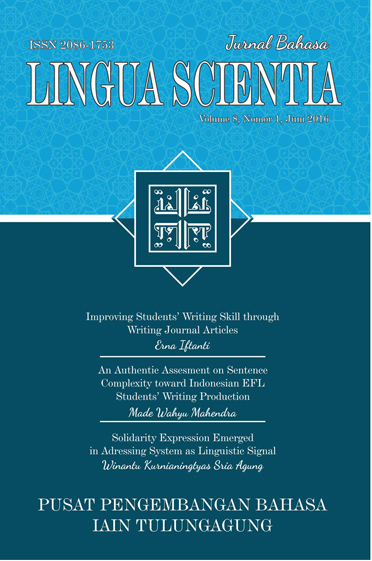
SOLIDARITY EXPRESSIONS EMERGED IN ADDRESSING SYSTEM AS LINGUISTIC SIGNAL
DOI:
https://doi.org/10.21274/ls.2016.8.1.21-30Keywords:
personal deixis, solidarityAbstract
Language has the particular roles relevant to the situation and event when the communication holds. In taking a part into a communication, the speaker must understand in what context they speak whether he speaks in formal or informal context. Moreover, the role-relationship between the speaker and hearer, for instance, the communication between parents to children, a boss and his employee. Then, the setting of the communication, for example, at home, offce, market, etc also becomes the major factors in conducting communication. Language allows community not only to communicate with others but also to establish personal identity among individuals and communities. The social class or social stratifcation exists in the term of power and solidarity. The existence of power and solidarity reflects in the way people communicate with others and it can be seen through thelanguage they use.
Downloads
References
Coupland, Nikolas and Adam Jaworski. 1997. Sociolinguistics A Reader and Coursebook. United States of America: St. Martin’s Press.
Cruse, D. A. 2004. Meaning in Language: An Introduction to Semantics and Pragmatics. Oxford: Oxford University Press.
Hudson, R. A. 1980. Sociolinguistics. Cambridge: Cambridge University Press.
Levinson, Stephen C. 1983. Pragmatics. Cambridge: Cambridge University Press.
Littlejohn, Stephen. 2008. Theories of Human Communication. California: Wadsworth Publishing.
Trudgill, Peter. 1974. Sociolinguistics: An Introduction. Great Britain: Hazell Watson and Virey Ltd.
Verhaar, J. W. M. 1993. Pengantar Linguistik. Yogyakarta: GajahMada University Press
Downloads
Published
How to Cite
Issue
Section
License
Copyright
Authors who publish with this journal agree to the following terms:
a. Authors retain copyright and grant the journal right of first publication with the work simultaneously licensed under a Creative Commons Attribution-ShareAlike 4.0 International License that allows others to share the work with an acknowledgment of the work's authorship and initial publication in this journal.
b. Authors are able to enter into separate, additional contractual arrangements for the non-exclusive distribution of the journal's published version of the work (e.g., post it to an institutional repository or publish it in a book), with an acknowledgment of its initial publication in this journal.
c. Authors are permitted and encouraged to post their work online (e.g., in institutional repositories or on their website) prior to and during the submission process, as it can lead to productive exchanges, as well as earlier and greater citation of published work (See The Effect of Open Access).