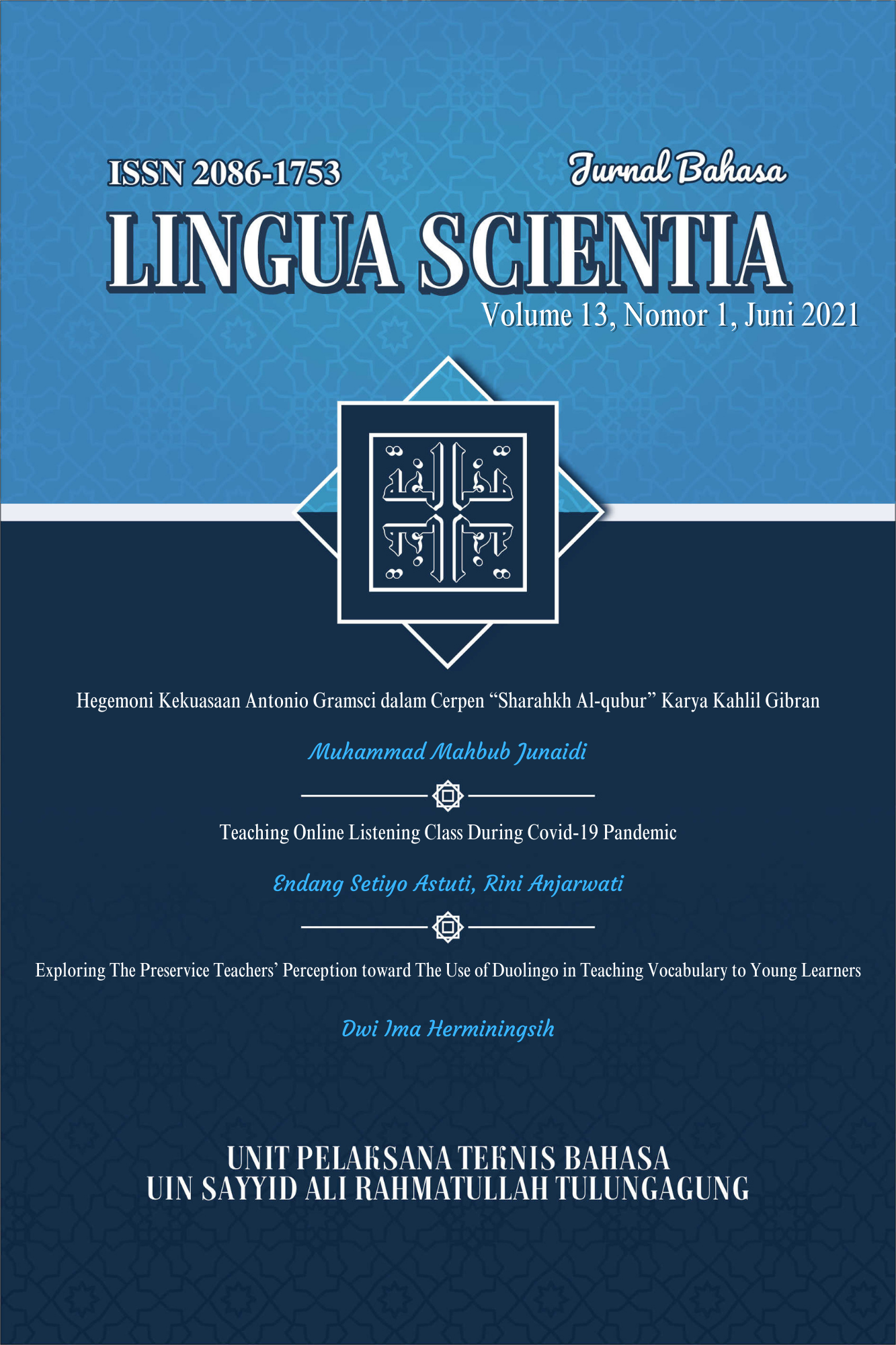
TEACHING ONLINE LISTENING CLASS DURING COVID-19 PANDEMIC
DOI:
https://doi.org/10.21274/ls.2021.13.1.27-39Keywords:
teaching Listening, listening class, Covid-19 PandemicAbstract
This article discusses about how teaching listening class was implemented in the English practice program during covid-19 pandemic. Descriptive method was applied to find out whether selected material utilized by effective instructional media could meet the learning objective of the English practice program. The result showed that both the intensive and extensive material in listening class could be applied by using some media that can be used during online class by considering both students and instructors’ internet access. The selected online media platform that can replace face-to-face meeting is Google Meet application, while Google Classroom, YouTube, and WhatsApp application are selected to share and submit the class’s assignments. The teacher’s role in engaging the students with particular activities are highlighted.
Downloads
References
Aldina, Mia et.al. (2020) Students’ Challenges in Listening in Virtual Classroom; Case Study In English Education Study Program In Covid-19. Proceeding of Shepo 2020 (International Conference On Social Sciences & Humanity, Economics, And Politics)
Creswell, John W. (2009). Research Design. Qualitative Quantitative and Mixed Methods. Sage Publication Inc.
Canary, Austin. (Oct 10, 2019) How to Analyse Interview Transcript in Qualitative Research. https://www.rev.com/blog/analyze-interview-transcripts-in-qualitative-research
Harmer, Jeremy (2007). The Practice of English Language Teaching. Pearson Education.
Kajiura, Mayumi (2021). Brain and Language 212. 104839.
Lapitan, Lorico Ds. Jr et all (April 2020). An Effective Blended Online Teaching and Learning Strategy during the Covid-19 Pandemic. Education for Chemical Engineer Vol. 35, pages 116-131.
Mahaye, Ngogi Emmanuel (23 April 2020). The Impact of Covid-19 Pandemic on Education: Navigating Forward the Pedagogy of Blended Learning. https://www.researchgate.net/project/The-Impact-of-COVID-19-Pandemic-on-South-African-Education-Navigating-Forward-the-Pedagogy-of-Blended-Learning-dagogy
Mishra, Lokanath et all (2020). Online Teaching-Learning in Higher Education during Lockdown Period of Covid-19 Pandemic. International Journal of Education Research Open Vol. 1
Moser, Kelly M, et all (2020). Remote teaching during Covid-19: Implication from a National Survey of Language Educator. Journal System 97 (4).
Nunan, David (2015). Teaching English to Speakers of Other Languages: An Introduction. Routledge 711 Third Avenue, New York, NY 10017.
Susilowati (September, 2020). The Challenge of Online learning in Listening Class during Covid-19 Pandemic. Journal Elsa vol. 18 no 20.
Vo, Y. (2013). Developing Extensive Listening for EFL Learners Using Internet Resources. Hawaii pacific University TESOL Working paper Series 11, 29-51.
Zhang, Xue (2020). Learning and Individual Differences Vol. 79, April 2020, 101856. https://www.rev.com/blog/analyze-interview-transcripts-in-qualitative-research
Downloads
Published
How to Cite
Issue
Section
License
Copyright
Authors who publish with this journal agree to the following terms:
a. Authors retain copyright and grant the journal right of first publication with the work simultaneously licensed under a Creative Commons Attribution-ShareAlike 4.0 International License that allows others to share the work with an acknowledgment of the work's authorship and initial publication in this journal.
b. Authors are able to enter into separate, additional contractual arrangements for the non-exclusive distribution of the journal's published version of the work (e.g., post it to an institutional repository or publish it in a book), with an acknowledgment of its initial publication in this journal.
c. Authors are permitted and encouraged to post their work online (e.g., in institutional repositories or on their website) prior to and during the submission process, as it can lead to productive exchanges, as well as earlier and greater citation of published work (See The Effect of Open Access).