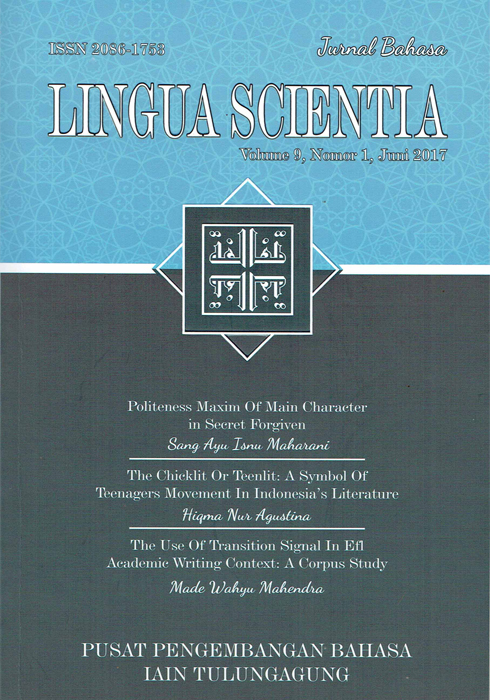
THE CHICKLIT OR TEENLIT: A SYMBOL OF TEENAGERS MOVEMENT IN INDONESIA’S LITERATURE
DOI:
https://doi.org/10.21274/ls.2017.9.1.73-86Keywords:
chicklit, Indonesia literature, movement, symbol, teenlit, teenagersAbstract
One of the genres of literature which becomes the trending topic in Indonesia is Chicklit or Teenlit. It reveals about young women and their life in many aspects. Mostly the arise of the new writers supported by the media, both electronic or printed, which become the tool to make them famous. Media’s power has taken a part to create their existence, mostly they are young generations in Indonesia; they also contribute the growth of the creative industry. They just became the new public figures like actress or actors who dominate the news in media. This paper is intended to analyze the signifcant role of media in creating the young new writers in Indonesia, especially one outstanding name, Debbie Widjaja. She has written four novels categorized as Teenlit. The qualitative method, the media, and society’s theory will be used to analyze this research. The results of this study showed the media’s role give the important part in creating the new public fgures in Indonesia. The media has a strong power to embody someone’s dream to be true in a good and potential way. Media construct people’s life from zero to be hero. By having this profession, as a young, fresh, and prospective writer, she has inspired many teenagers in Indonesia. Since there isn’t any strict limitations or ideal criteria to produce Teenlit, everybody who fulflled the publisher’s criteria can publish their writings. This becomes the new movement for young generations in Indonesia to have a career in literature world.Downloads
References
Gramedia (Toko Buku). Retrieved from: https://id.wikipedia.org/wiki/Gramedia_(toko_buku)
Hurlock, Elizabeth. (1994). Psikologi Perkembangan. Jakarta: Gramedia.
Kayam, Umar. (1981). Seni, Tradisi, Masyarakat. Jakarta: Sinar Harapan. Kompas Gramedia.Retrieved from: https://id.wikipedia.org/wiki/Kompas_Gramedia
Kurnia, R. S. (2016). Teenlit Sebagai Cermin Budaya Remaja Perkotaan Masa Kini. Bandung: CV. Angkasa.
Kusmarwanti. (2005). Teenlit dan Budaya Menulis di Kalangan Remaja. Retrieved from: http://staff.uny.ac.id/sites/default/fles/penelitian/Kusmarwanti,%20SS.,%20M.Pd.,%20M.A./TEENLIT%20DAN%20BUDAYA%20MENULIS.pdf.
McQuail, Denis. (2010). Mass Communication Theory. 6nd Edition. New York: SAGE Publication Ltd.
Nadia, Asma. (2007). Majalah Annida Edisi No. 3/XVII, 1-30 November 2007. Jakarta: Gramedia.
Nurgiyantoro, Burhan. (2005). Teori Pengkajian Fiksi. Yogyakarta: Gadjah Mada University Press.
Riana, Desri. (2016). Teenlite Dalam Sastra Indonesia. Bandung: Angkasa.
Wahyudi, Untung. (2012). Eksistensi Sastra dan Minat Baca-Tulis di Kalangan Remaja. 5 Agustus 2012. Retrieved from: http://www.riaupos.co/559-spesial-eksistensi-sastra-dan-minat-baca-tulis-dikalangan-remaja.html#.WLwdlTiw7Mw
Widjaja, Debbie. (2010). Honey Money. Jakarta: PT Gramedia Pustaka Utama.
____________ . (2015). My Ardent Adventure.Tags: Tips Menulis Novel. Passionate in Writing. Tanya Penulis Dengan Debbie Widjaja. July 24, 2015. Retrieved from: https://debbiewidjaja.com/tag/tipsmenulis-novel/
Downloads
Published
How to Cite
Issue
Section
License
Copyright
Authors who publish with this journal agree to the following terms:
a. Authors retain copyright and grant the journal right of first publication with the work simultaneously licensed under a Creative Commons Attribution-ShareAlike 4.0 International License that allows others to share the work with an acknowledgment of the work's authorship and initial publication in this journal.
b. Authors are able to enter into separate, additional contractual arrangements for the non-exclusive distribution of the journal's published version of the work (e.g., post it to an institutional repository or publish it in a book), with an acknowledgment of its initial publication in this journal.
c. Authors are permitted and encouraged to post their work online (e.g., in institutional repositories or on their website) prior to and during the submission process, as it can lead to productive exchanges, as well as earlier and greater citation of published work (See The Effect of Open Access).