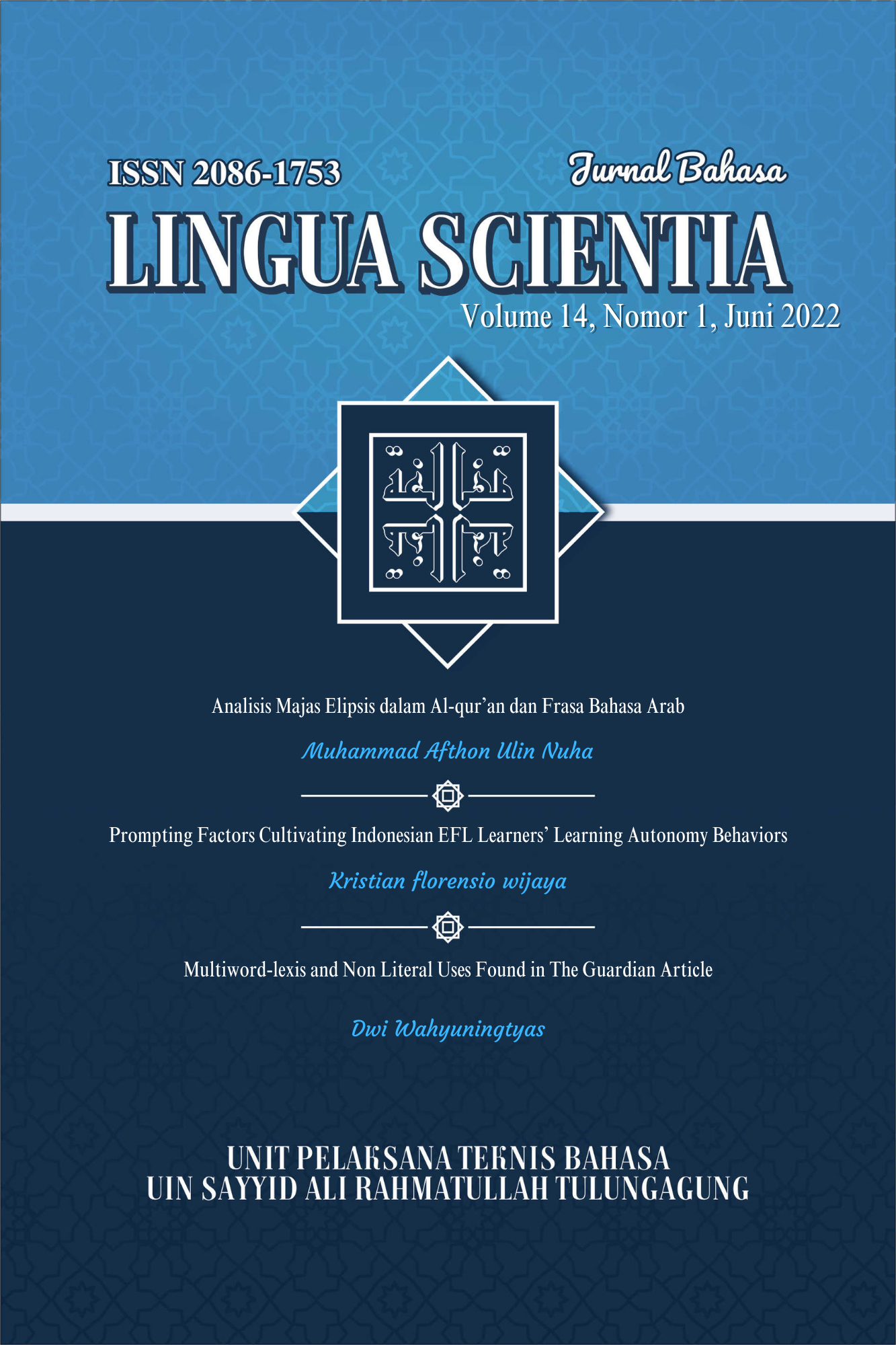
PROMPTING FACTORS CULTIVATING INDONESIAN EFL LEARNERS’ LEARNING AUTONOMY BEHAVIORS
DOI:
https://doi.org/10.21274/ls.2022.14.1.17-38Keywords:
Learning autonomy, Indonesian EFL learners, library studyAbstract
Previous research results unearthed that highly-autonomous EFL learners are more inclined to possess a higher sense of ownership of their learning enterprises owing to the advanced level of learning management. This library study was a further attempt enacted by the researcher to profoundly investigate particular factors believed to cultivate Indonesian EFL learners’ learning autonomy behaviors. In light of this major research objectivity, 30 previous learning autonomy literature were selectively selected to shed clearer enlightenment for Indonesian EFL experts, practitioners, curriculum designers, and educators to start internalizing various meaningful learning activities consolidating learners’ autonomous learning behaviors. Generally speaking, the obtained research results unveiled that the constant nourishment of Indonesian EFL learners’ learning autonomy behaviors can be insured in case second language teachers are committed to promoting more facilitative and innovative learning enterprises in their daily routines. In conformance with these research results, it is of foremost importance for second language teachers to organize their classroom learning dynamics harmonious with learners’ specific learning situations to advance their autonomous learning behaviors to greater development.
Downloads
Downloads
Published
How to Cite
Issue
Section
License
Copyright
Authors who publish with this journal agree to the following terms:
a. Authors retain copyright and grant the journal right of first publication with the work simultaneously licensed under a Creative Commons Attribution-ShareAlike 4.0 International License that allows others to share the work with an acknowledgment of the work's authorship and initial publication in this journal.
b. Authors are able to enter into separate, additional contractual arrangements for the non-exclusive distribution of the journal's published version of the work (e.g., post it to an institutional repository or publish it in a book), with an acknowledgment of its initial publication in this journal.
c. Authors are permitted and encouraged to post their work online (e.g., in institutional repositories or on their website) prior to and during the submission process, as it can lead to productive exchanges, as well as earlier and greater citation of published work (See The Effect of Open Access).