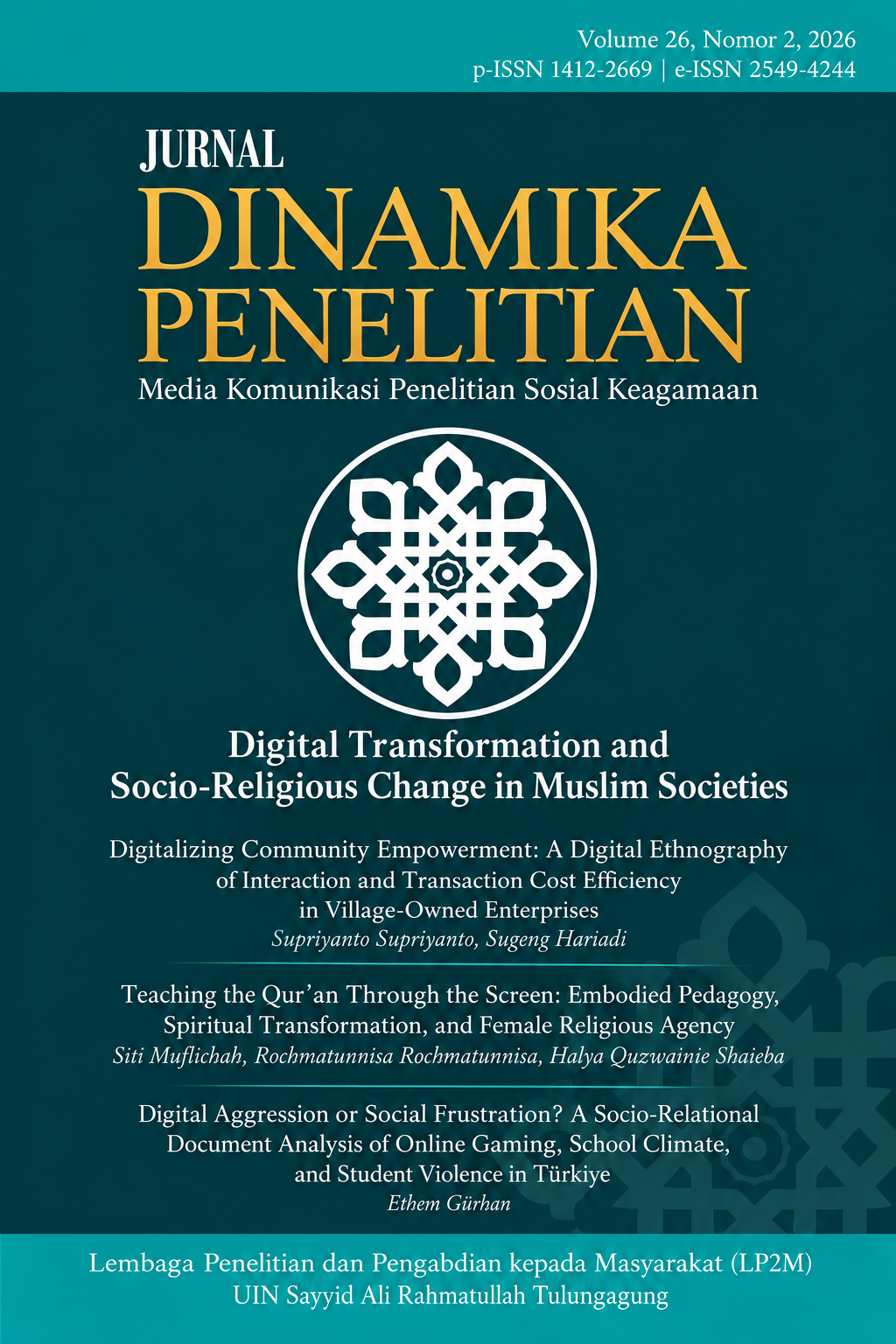
Digital Aggression or Social Frustration? A Socio-Relational Document Analysis of Online Gaming, School Climate, and Student Violence in Türkiye
DOI:
https://doi.org/10.21274/dinamika.2026.26.2.109-126Keywords:
Digital aggression; online gaming; school climate; social frustration; TürkiyeAbstract
Online gaming is often associated with student violence, but such claims rarely consider the social conditions in which aggression emerges. This study explores how gaming, social frustration, school climate, and peer and family relationships intersect in evidence concerning Türkiye. Using qualitative socio-relational document analysis, 25 of 34 candidate records were retained: eight Türkiye-specific records, one mixed-country synthesis with substantial Türkiye evidence, and 16 international or comparative records. Comparative coding, constant comparison, and negative-case analysis highlighted three patterns. Aggression was discussed alongside negative emotions, unmet social needs, weak social intelligence, and limited support rather than gaming exposure alone. School climate mattered through belonging, self-control, peer networks, and bystander responses. Gaming also served different functions: it could deepen frustration, offer coping, or foster competence and connection, depending on the circumstances and whether engagement was ordinary or problematic. These findings inform a Socio-Relational Digital Aggression Model that links digital experiences with students' relational environments. The model identifies plausible pathways for further study rather than establishing causal relationships for Türkiye. Prevention should therefore distinguish forms of gaming while strengthening school connectedness, family support, media literacy, and positive peer relationships.
Downloads
References
Aslan, H., Başcıllar, M., & Karataş, K. (2022). Ergenlerde dijital oyun bağımlılığı ile sosyal beceriler arasındaki ilişki. Bağımlılık Dergisi, 23(3), 266–274. https://doi.org/10.51982/bagimli.1033761
Bardach, L., Graf, D., Yanagida, T., Kollmayer, M., Spiel, C., & Lüftenegger, M. (2020). Gendered pathways to bullying perpetration via social achievement goals: Mediating effects of sense of belonging and non-inclusive group norms. Journal of School Violence, 19(2), 248–263. https://doi.org/10.1080/15388220.2019.1660883
Boz, C., & Dinç, M. (2023). Examination of game addiction studies conducted in Turkey: A systematic review study. Frontiers in Psychiatry, 14, Article 1014621. https://doi.org/10.3389/fpsyt.2023.1014621
Diyanet İşleri Başkanlığı. (2014). Türkiye’de dinî hayat araştırması. https://www.ceidizleme.org/ekutuphaneresim/dosya/914_1.pdf
Drummond, A., Sauer, J. D., & Ferguson, C. J. (2020). Do longitudinal studies support long-term relationships between aggressive game play and youth aggressive behaviour? A meta-analytic examination. Royal Society Open Science, 7(7), Article 200373. https://doi.org/10.1098/rsos.200373
Gürkan, H., Atabay, E., & Gezgin, D. M. (2022). Lise öğrencileri arasında dijital şiddet: Siber zorbalık, akıllı telefon bağımlılığı ve medya okuryazarlık arasındaki ilişki. Trakya Eğitim Dergisi, 12(3), 1799–1820. https://doi.org/10.24315/tred.1115385
Han, T. S., Cho, H., Sung, D., & Park, M.-H. (2022). A systematic review of the impact of COVID-19 on the game addiction of children and adolescents. Frontiers in Psychiatry, 13, Article 976601. https://doi.org/10.3389/fpsyt.2022.976601
Karakul, A., & Bozkul, G. (2024). The relationship between digital game addiction and the bullying tendencies of secondary school students from a district in southern Turkey. Ordu University Journal of Nursing Studies, 7(2), 514–523. https://doi.org/10.38108/ouhcd.1261215
Köse, S., Ayran, G., & Aslan, İ. (2024). The effect of digital game addiction on aggression in school-age children. Karya Journal of Health Science, 5(2), 33–39. https://doi.org/10.52831/kjhs.1433013
Lee, S. J., Jeong, E. J., Choi, J. I., & Park, M. S. (2024). Social intelligence and pathological gaming: A longitudinal study of the associations among negative emotions, social intelligence, aggression, and pathological gaming in adolescents. Frontiers in Psychiatry, 15, Article 1353969. https://doi.org/10.3389/fpsyt.2024.1353969
Lesage, K., Starr, K., & Miner, W. (2025). Around the world, many people are leaving their childhood religions. Pew Research Center. https://doi.org/10.58094/xt5h-b241
Li, H., Gan, X., Xiang, G.-X., Zhou, T., Wang, P., Jin, X., & Zhu, C. (2022). Peer victimization and problematic online game use among Chinese adolescents: The dual mediating effect of deviant peer affiliation and school connectedness. Frontiers in Psychology, 13, Article 823762. https://doi.org/10.3389/fpsyg.2022.823762
Li, S., Wu, Z., Zhang, Y., Xu, M., Wang, X., & Ma, X. (2023). Internet gaming disorder and aggression: A meta-analysis of teenagers and young adults. Frontiers in Public Health, 11, Article 1111889. https://doi.org/10.3389/fpubh.2023.1111889
Li, Z., Yu, C., & Nie, Y. (2021). The association between school climate and aggression: A moderated mediation model. International Journal of Environmental Research and Public Health, 18(16), Article 8709. https://doi.org/10.3390/ijerph18168709
Montero-Carretero, C., Pastor, D., Santos-Rosa, F. J., & Cervelló, E. (2021). School climate, moral disengagement and empathy as predictors of bullying in adolescents. Frontiers in Psychology, 12, Article 656775. https://doi.org/10.3389/fpsyg.2021.656775
Mroczkowski, M. M., Walkup, J. T., & Appelbaum, P. S. (2021). Assessing violence risk in adolescents in the pediatric emergency department: Systematic review and clinical guidance. Western Journal of Emergency Medicine, 22(3), 533–542. https://doi.org/10.5811/westjem.2021.1.49233
Nagar, K., Patidar, A. K., Mudgal, S. K., Gaur, R., & Patidar, V. (2025). Relationship of digital game addiction with aggression and anger in the post COVID-19 era: A systematic review and meta-analysis. Investigación y Educación en Enfermería, 43(2), Article e13. https://doi.org/10.17533/udea.iee.v43n2e13
Park, M. S.-A., Golden, K. J., Vizcaino-Vickers, S., Jidong, D., & Raj, S. (2021). Sociocultural values, attitudes and risk factors associated with adolescent cyberbullying in East Asia: A systematic review. Cyberpsychology: Journal of Psychosocial Research on Cyberspace, 15(1), Article 5. https://doi.org/10.5817/CP2021-1-5
Pina, D., Marín-Talón, M. C., López-López, R., Martínez-Sánchez, A., Cormos, L. S., Ruiz-Hernández, J. A., Abecia, B., & Martínez-Jarreta, B. (2021). Attitudes toward school violence against LGBTQIA+: A qualitative study. International Journal of Environmental Research and Public Health, 18(21), Article 11389. https://doi.org/10.3390/ijerph182111389
Pinchak, N. P. (2024). A paradox of school social organization: Positive school climate, friendship network density, and adolescent violence. Journal of Youth and Adolescence, 53(11), 2623–2641. https://doi.org/10.1007/s10964-024-02034-2
Przybylski, A. K., & Weinstein, N. (2019). Violent video game engagement is not associated with adolescents' aggressive behaviour: Evidence from a registered report. Royal Society Open Science, 6(2), Article 171474. https://doi.org/10.1098/rsos.171474
Santric-Milicevic, M., Stevanovic, A., Popovac, N., Milanovic, F., Dedovic, S., Zdravkovic, M., Bjelica, N., Tomasevic, R., Todorovic, J., Terzic-Supic, Z., Obradovic-Tomasevic, B., Milovanovic, V., Radosavljevic, N., & Nikolic, D. (2022). Participation in bullying and associated health characteristics, risk factors and leisure activities: A profile of school-age children in Serbia. International Journal of Environmental Research and Public Health, 19(15), Article 9159. https://doi.org/10.3390/ijerph19159159
Sevinçli, M. C., & Eğer Aydoğmuş, M. (2022). Öz belirleme kuramı temelinde bir müdahale aracı olarak video oyunları. Psikiyatride Güncel Yaklaşımlar, 14(2), 207–220. https://doi.org/10.18863/pgy.974968
Shao, R., & Wang, Y. (2019). The relation of violent video games to adolescent aggression: An examination of moderated mediation effect. Frontiers in Psychology, 10, Article 384. https://doi.org/10.3389/fpsyg.2019.00384
Ulaş, E., & Incekara, H. I. (2026). The role of Machiavellianism, cyberbullying, and family relationships in adolescent gaming addiction: A problem behavior theory approach. Frontiers in Psychology, 17, Article 1794127. https://doi.org/10.3389/fpsyg.2026.1794127
Waasdorp, T. E., Fu, R., Clary, L. K., & Bradshaw, C. P. (2022). School climate and bullying bystander responses in middle and high school. Journal of Applied Developmental Psychology, 80, Article 101412. https://doi.org/10.1016/j.appdev.2022.101412
Yıldırım, E., & Zeren, S. G. (2021). Video game addiction in Turkey: Does it correlate between basic psychological needs and perceived social support? Psycho-Educational Research Reviews, 10(2), 106–117. https://doi.org/10.52963/PERR_Biruni_V10.N2.07
Downloads
Additional Files
Published
How to Cite
Issue
Section
License
Copyright (c) 2026 Ethem Gürhan

This work is licensed under a Creative Commons Attribution 4.0 International License.