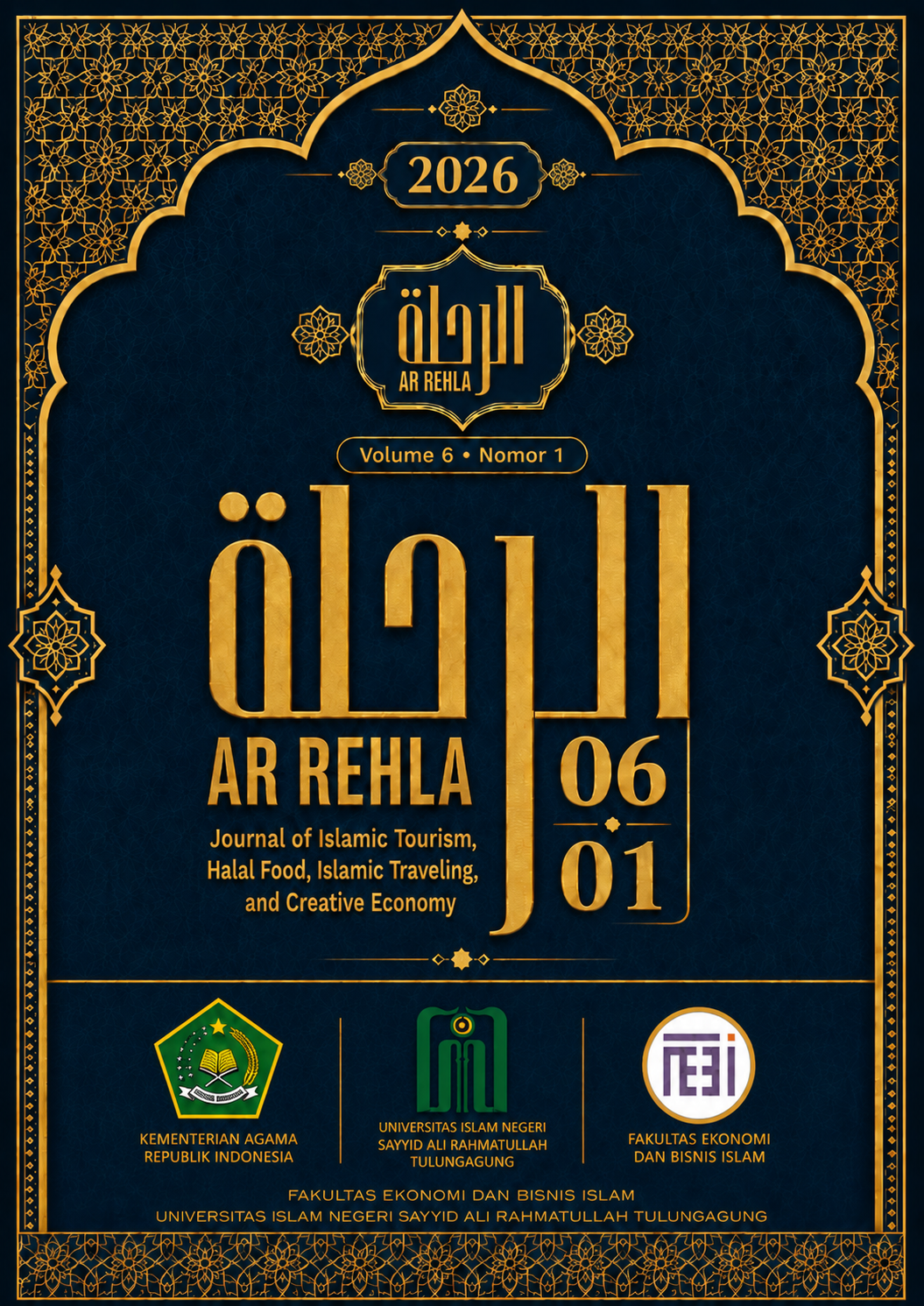
DIGITAL TRANSFORMATION OF MSMEs SUPPORTING HALAL TOURISM
The Influence of Human Resource Quality, Product Innovation, and Sharia Marketing Strategies on Business Sustainability in Jember Regency
DOI:
https://doi.org/10.21274/ar-rehla.v6i1.12126Keywords:
Halal Tourism, MSMEs, Digital Transformation, Human Resource Quality, Sharia Marketing, Business SustainabilityAbstract
Abstract: This study examines the sustainability of Micro, Small, and Medium Enterprises (MSMEs) supporting halal tourism through the lens of organizational capability synergy. It investigates the influence of human resource quality, product innovation, and sharia marketing strategies on business sustainability, with digital transformation positioned as an integrative enabling capability. Using a quantitative approach, data were collected from MSME actors in Jember Regency and analyzed using Structural Equation Modeling (SEM). The findings reveal that human resource quality, product innovation, and sharia marketing strategies have significant positive effects on both digital transformation and business sustainability. Digital transformation further strengthens these relationships by integrating technological systems with human competencies, innovation processes, and ethical market practices. The study proposes a capability-synergy framework demonstrating that sustainability in halal-oriented MSMEs is not solely driven by technology or market forces but by the interaction of economic, technological, and normative-religious capabilities. The results contribute to the development of human capital theory, innovation theory, Islamic marketing, and dynamic capability perspectives within the context of halal tourism. Practically, the study highlights the importance of capacity building, innovation development, and ethical marketing literacy alongside digital infrastructure support to enhance MSME resilience and long-term competitiveness.
Keywords: Halal Tourism; MSMEs; Digital Transformation; Human Resource Quality; Sharia Marketing; Business Sustainability.
Abstract: Penelitian ini mengkaji keberlanjutan Usaha Mikro, Kecil, dan Menengah (UMKM) pendukung pariwisata halal melalui perspektif sinergi kapabilitas organisasi. Studi ini menganalisis pengaruh kualitas sumber daya manusia, inovasi produk, dan strategi pemasaran syariah terhadap keberlanjutan usaha dengan transformasi digital sebagai kapabilitas integratif. Pendekatan kuantitatif digunakan dengan pengumpulan data dari pelaku UMKM di Kabupaten Jember yang dianalisis menggunakan Structural Equation Modeling (SEM). Hasil penelitian menunjukkan bahwa kualitas sumber daya manusia, inovasi produk, dan strategi pemasaran syariah berpengaruh positif signifikan terhadap transformasi digital dan keberlanjutan usaha. Transformasi digital memperkuat hubungan tersebut dengan mengintegrasikan sistem teknologi, kompetensi manusia, proses inovasi, dan praktik pasar yang berlandaskan etika. Penelitian ini menawarkan kerangka sinergi kapabilitas yang menegaskan bahwa keberlanjutan UMKM berbasis halal tidak hanya ditentukan oleh teknologi atau faktor pasar, tetapi oleh interaksi antara kapabilitas ekonomi, teknologi, serta nilai normatif-religius. Temuan ini berkontribusi pada pengembangan teori modal manusia, teori inovasi, pemasaran Islam, dan kapabilitas dinamis dalam konteks pariwisata halal. Secara praktis, penelitian ini menekankan pentingnya penguatan kapasitas, pengembangan inovasi, dan literasi pemasaran etis yang sejalan dengan dukungan infrastruktur digital guna meningkatkan resiliensi dan daya saing jangka panjang UMKM.
Keywords: Pariwisata Halal; UMKM, Transformasi Digital; Kualitas SDM; Pemasaran Syariah; Keberlanjutan Usaha.
Downloads
References
Armawi, A., Danugroho, A., Apriliyanti, K., & Asrofi, A. (2022). Smart Environment Program’s Traffic Management to Achieve Semarang City Resilience. Journal of Governance and Public Policy.
Atiase, V. Y., Mahmood, S., Wang, Y., & Botchie, D. (2018). Developing entrepreneurship in Africa: investigating critical resource challenges. Journal of Small Business and Enterprise Development. https://doi.org/10.1108/JSBED-03-2017-0084
Azhari, D., & Asmuni, A. (2023). Progressive Steps in Reforming Indonesian Islamic Family Law Through Gender Studies. Syakhshiyyah Jurnal Hukum Keluarga Islam. https://doi.org/10.32332/syakhshiyyah.v3i2.8020
Bangun, W. (2012). Manajemen Sumber Daya Manusia. Jakarta: Erlangga.
Battour, M., Ismail, M. N., & Battor, M. (2011). The Impact of Destination Attributes on Muslim Tourist’s Choice. International Journal of Tourism Research, 13(6), 527–540. https://doi.org/10.1002/jtr.824
Becker, G. S. (1993). Human Capital: A Theoretical and Empirical Analysis, with Special Reference to Education (3rd ed.). University of Chicago Press. https://doi.org/10.7208/chicago/9780226041223.001.0001
Bowles Eagle, R. (2021). How to Start A Human Rights Film Festival: Expertise, Training and Collective Media Activism. European Journal of Cultural Studies. https://doi.org/10.1177/1367549418821842
Buntoro, G. A., Astuti, I. P., Widhianingrum, W., Arifin, R., Winangun, K., & Selamat, A. (2023). Knowledge Management System for Handcrafted Reog Ponorogo Products. Electronic Journal of Knowledge Management. https://doi.org/10.34190/EJKM.21.2.3026
Burhannuddin, M. A., & Danugroho, A. (2021). Pesta Rakyat ditengah Krisis: Partisipasi Masyarakat Pada Pilkada Sebelum dan Pada Saat Pandemi Covid-19. Proceeding International Relations on Indonesian Foreign Policy Conference. https://doi.org/10.33005/irofonic.v1i1.18
Clay, N. (2016). Producing Hybrid Forests in The Congo Basin: A Political Ecology of The Landscape Approach to Conservation. Geoforum. https://doi.org/10.1016/j.geoforum.2016.09.008
Creswell, J. W. (2016). Research Design, Pendekatan Metode Kualitatif, Kuantitaif, dan Campuran. 4th ed. Pustaka Belajar.
Danugroho, A. (2022a). Mengartikan Ketahanan Nasional. Pustaka Aksara. https://www.pustakaaksara.co.id/view/73
Danugroho, A. (2022b). Threats To Food Security in The Food and Energi Barn Area: Agricultural Land Function Change in Bojonegoro Regency. ARISTO, 10(2), 218–231. https://doi.org/10.24269/ars.v10i2.5056
Danugroho, A., Rustinsyah, R., & Adib, M. (2026). Digital Pathways of Culture: Technoscape, Mediascape, and The Reconfiguration of Osing Identity in Banyuwangi. International Review of Sociology. https://doi.org/10.1080/03906701.2026.2614012
Danugroho, A., Rustinsyah, R., Adib, M., Ardyawin, I., Idris, U., & Habib, M. A. F. (2025). Ritual, Ecology, and Climate Change: An Ethnoecological Study of Agricultural Communities in East Java. Social Sciences & Humanities Open, 12, 102061. https://doi.org/10.1016/j.ssaho.2025.102061
Danugroho, A., & Sa’adah, A. H. (2021). Cash Waqf Linked Sukuk (CWLS) di Tengah Pandemi Covid-19 dan Implementasinya terhadap Ketahanan Ekonomi. Proceeding International Relations on Indonesian Foreign Policy Conference. https://doi.org/10.33005/irofonic.v1i1.10
Danugroho, A., & Yusfira, F. (2023). Management Policy for Oil and Gas Sector of Bojonegoro Regency Government in Kang Yoto Era. TRANSFORMASI: Jurnal Manajemen Pemerintahan. https://doi.org/10.33701/jtp.v15i1.2510
Hadi, D. P., Adi, P. H., Arintoko, & Ahmad, A. A. (2023). The Impact of the Omnibus Low Cipta Kerja on the Sustainability of MSMEs and Economic Growth by Applying the Canvas Model Business Method and the Use of Financial Technology, Especially Crowdfunding and Microfinance. International Journal of Sustainable Development and Planning. https://doi.org/10.18280/ijsdp.180219
Hair Howard, M. C., & Nitzl, C., J. F. (2020). Assessing Measurement Model Quality in PLS‑SEM Using Confirmatory Composite Analysis. Journal of Business Research. https://doi.org/https://doi.org/10.1016/j.jbusres.2019.11.069
Hair, J. F., Black, W. C., Babin, B. J., & Anderson, R. E. (2010). Multivariate Data Analysis (7th ed.). Pearson Education.
Henderson, J. C. (2010). Sharia-Compliant Hotels. Tourism and Hospitality Research, 10(3), 246–254. https://doi.org/10.1057/thr.2010.3
Jamali, D. R., El Dirani, A. M., & Harwood, I. A. (2015). Exploring Human Resource Management Roles in Corporate Social Responsibility: The CSR-HRM Co-Creation Model. Business Ethics. https://doi.org/10.1111/beer.12085
Kotler, P. (2001). Manajemen Pemasaran: Analisis, Perencanaan, Implementasi, dan Kontrol. PT. Prehallindo.
Mashuri, I. (2020). Implementation of Sharia Compliance in The Halal Tourism Industry In Indonesia (A Study on Sharia Hotels and Beaches). Prophetic Law Review. https://doi.org/10.20885/plr.vol2.iss2.art5
Rahayu, S. K., Budiarti, I., Firdaus, D. W., & Onegina, V. (2023). Digitalization and Informal Msme: Digital Financial Inclusion for Msme Development in The Formal Economy. Journal of Eastern European and Central Asian Research. https://doi.org/10.15549/jeecar.v10i1.1056
Robiatun, F., Danugroho, A., & Halimatussa’adah, A. (2021). Perjalanan Sejarah Wakaf dalam Mendukung Ketahanan Ekonomi di Tengah Pandemi Covid-19. Jurnal Paradigma: Jurnal Multidisipliner Mahasiswa Pascasarjana Indonesia.
Shen, J., & Zhang, H. (2019). Socially Responsible Human Resource Management and Employee Support for External CSR: Roles of Organizational CSR Climate and Perceived CSR Directed Toward Employees. Journal of Business Ethics. https://doi.org/10.1007/s10551-017-3544-0
Shepherd, R. (2002). Commodification, Culture and Tourism. Tourist Studies, 2(2), 183–201. https://doi.org/10.1177/146879702761936653
Sindhwani, R., Hasteer, N., Behl, A., Varshney, A., & Sharma, A. (2023). Exploring “what,” “why” and “how” of resilience in MSME sector: a m-TISM approach. Benchmarking. https://doi.org/10.1108/BIJ-11-2021-0682
Valdés, G., Solar, M., Astudillo, H., Iribarren, M., Concha, G., & Visconti, M. (2011). Conception, Development and Implementation of An E-Government Maturity Model in Public Agencies. Government Information Quarterly. https://doi.org/10.1016/j.giq.2010.04.007
Wahyudi, H., Puji Wahyuningsih, T., & Anggi Palupi, W. (2022). Pengembangan Wisata Halal di Pulau Pahawang, Kabupaten Pesawaran, Provinsi Lampung Development of Halal Tourism in Pahawang Island, Pesawaran Regency, Lampung Province. Research Journal on Islamic Finance.
Yahya, Y. K., Uzair, A., & Rofiqo, A. (2022). Indonesian Policy on Muslim Friendly Tourism: Geopolitical Overview. Journal of Critical Realism in Socio-Economics (JOCRISE). https://doi.org/10.21111/jocrise.v1i1.7
Yanidin, R., Abubakar, M. Bin, & Akmal, M. (2020). The Local Government Strategies in Building Halal Tourism in Bener Meriah Regency. Malikussaleh Social and Political Reviews. https://doi.org/10.29103/mspr.v1i1.3138
Downloads
Published
How to Cite
Issue
Section
License
Copyright (c) 2026 Rozy Khadafi

This work is licensed under a Creative Commons Attribution-ShareAlike 4.0 International License.
All articles published in Ar Rehla: Journal of Islamic Tourism, Halal Food, Islamic Traveling, and Creative Economy are licensed under a Creative Commons Attribution-ShareAlike 4.0 International (CC BY-SA) license. This means anyone is free to copy, transform, or redistribute articles for any lawful purpose in any medium, provided they give appropriate attribution to the original author(s) and Ar Rehla, link to the license, indicate if changes were made, and redistribute any derivative work under the same license.
Copyright on articles is retained by the respective author(s), without restrictions. A non-exclusive license is granted to Ar Rehla to publish the article and identify itself as its original publisher, along with the commercial right to include the article in a hardcopy issue for sale to libraries and individuals.
Although the conditions of the CC BY-SA license don't apply to authors (as the copyright holder of your article, you have no restrictions on your rights), by submitting to Ar Rehla, authors recognize the rights of readers, and must grant any third party the right to use their article to the extent provided by the license.