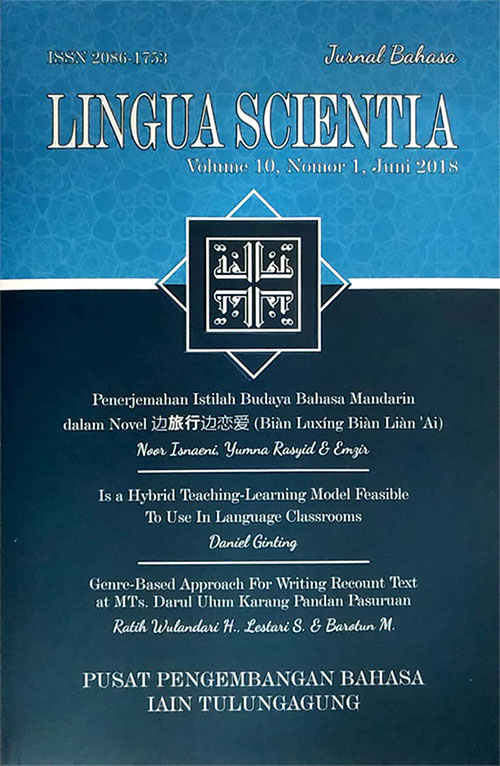
Penamaan Bunyi Segmental dan Suprasegmental Pada Pedagang Keliling
DOI:
https://doi.org/10.21274/ls.2018.10.1.1-16Keywords:
Phonology, Sound, Segmental, Suprasegmental, Roving TradersAbstract
The study, titled "The Naming of Segmental and Suprasegmental Sound to Mobile Traders" aims to describe the forms of naming the segmental and suprasegmental sounds used by the traveling traders. The type of research used is descriptive qualitative method whose data have been obtained, classified, classified, interpreted and then analyzed to obtain the data being studied. The results of this study indicate that there is uniqueness that is spoken between fellow traders located at the sound level.
Downloads
References
Chaer, Abdul. 2013. Fonologi Bahasa Indonesia. Jakarta: PT Rineka Cipta.
__________. 2007. Linguistik Umum. Jakarta: PT Rineka Cipta.
Gardjito. 2003. Hasil Temuan Makanan Tradisional. Surakarta: PT Punjabi Press.
Maruanaya, Ritha. 2007. Analisis Interpretasi Fonem Segmental dan Suprasegmental Mahasiswa Program Studi Pendidikan Bahasa Jerman. Tanoar, Vol. 5 No. 2. 1-15.
Muslich, Mansur. 2008. Fonologi Bahasa Indonesia Tinjauan Deskriptif Sistem Bunyi Bahasa Indonesia. Jakarta: Bumi Aksara.
Riana, Hanna. 2016. Manajemen Pemasaran. Bandung: Pamong Praja.
Verhaar, J. W. M. 2010. Asas-Asas Linguistik umum. Yogyakarta: Gadjah Mada University Press.
Downloads
Published
How to Cite
Issue
Section
License
Copyright
Authors who publish with this journal agree to the following terms:
a. Authors retain copyright and grant the journal right of first publication with the work simultaneously licensed under a Creative Commons Attribution-ShareAlike 4.0 International License that allows others to share the work with an acknowledgment of the work's authorship and initial publication in this journal.
b. Authors are able to enter into separate, additional contractual arrangements for the non-exclusive distribution of the journal's published version of the work (e.g., post it to an institutional repository or publish it in a book), with an acknowledgment of its initial publication in this journal.
c. Authors are permitted and encouraged to post their work online (e.g., in institutional repositories or on their website) prior to and during the submission process, as it can lead to productive exchanges, as well as earlier and greater citation of published work (See The Effect of Open Access).