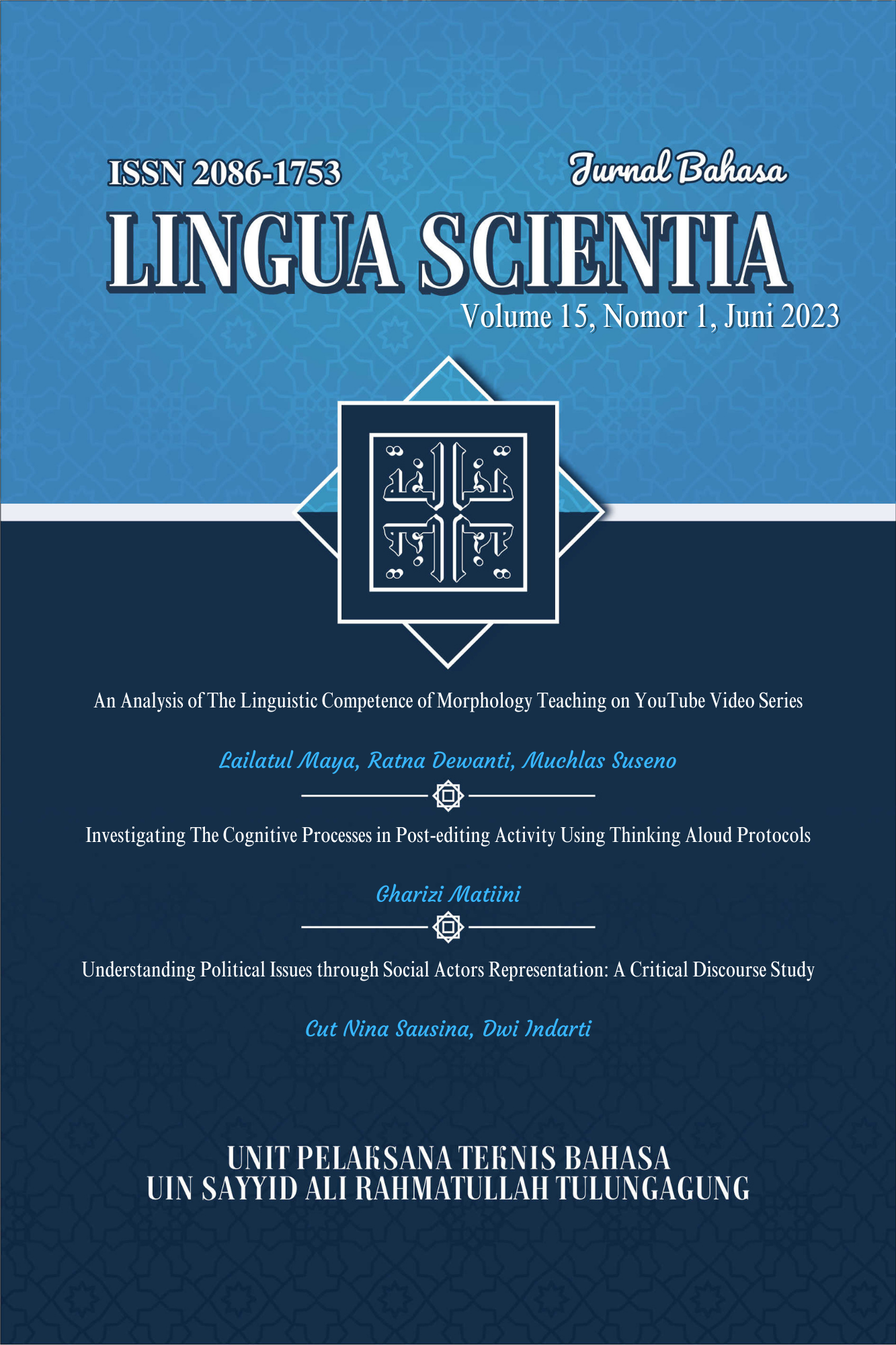
ANALISIS KESALAHAN BERBAHASA DALAM TATARAN SEMANTIK PADA POSTINGAN AKUN INSTAGRAM @demauinsurakarta
DOI:
https://doi.org/10.21274/ls.2023.15.1.209-226Keywords:
Language Errors, Semantics, Instagram AccountsAbstract
This research is motivated by the use of the Indonesian language where there are still many errors found, especially at the semantic level. The purpose of this study is to find out language errors at the semantic level contained in the @demauinsurakarta account. This study uses a qualitative descriptive method approach. The data source in this study is the account caption @demauinsurakarta. This study uses data analysis methods in the form of references from the Kamus Besar Bahasa Indonesia (KBBI) and Pedoman Umum Ejaan Bahasa Indonesia (PUEBI). The results of this study found semantic level errors in the field of hypercorrection found 7 errors, pleonasm found 8 errors, inappropriate word choice or diction found 3 errors and word selection which resulted in ambiguity meaning found 3 errors.
Downloads
Downloads
Published
How to Cite
Issue
Section
License
Copyright
Authors who publish with this journal agree to the following terms:
a. Authors retain copyright and grant the journal right of first publication with the work simultaneously licensed under a Creative Commons Attribution-ShareAlike 4.0 International License that allows others to share the work with an acknowledgment of the work's authorship and initial publication in this journal.
b. Authors are able to enter into separate, additional contractual arrangements for the non-exclusive distribution of the journal's published version of the work (e.g., post it to an institutional repository or publish it in a book), with an acknowledgment of its initial publication in this journal.
c. Authors are permitted and encouraged to post their work online (e.g., in institutional repositories or on their website) prior to and during the submission process, as it can lead to productive exchanges, as well as earlier and greater citation of published work (See The Effect of Open Access).